
How is National Insurance calculated? 2026/27 rates and worked examples
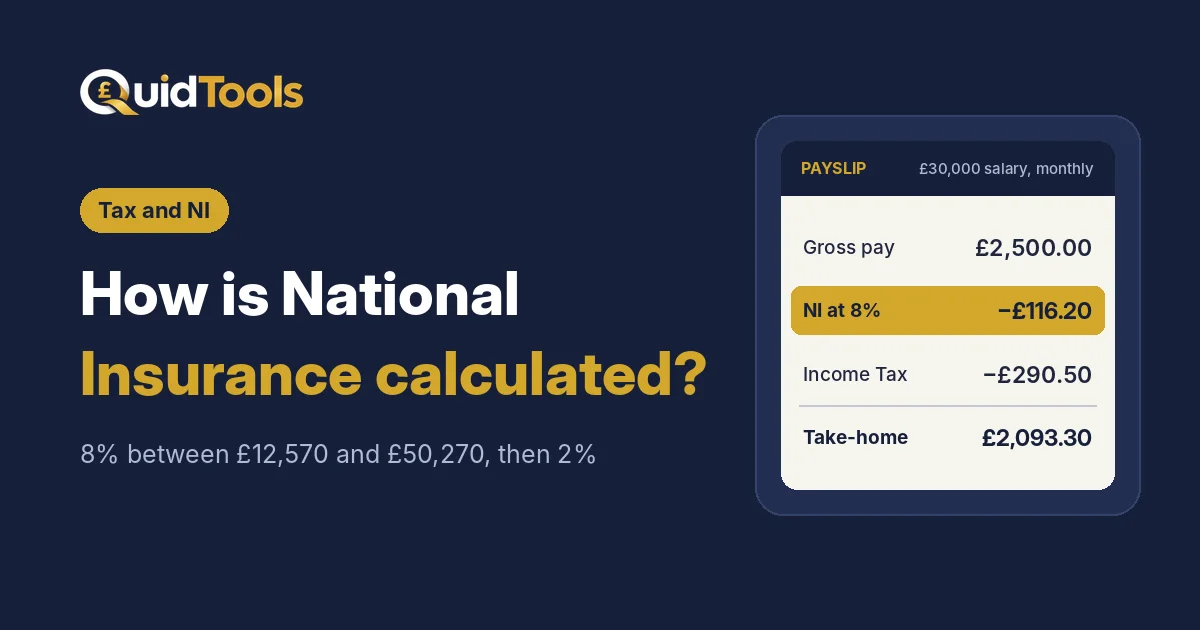
You look at your payslip and National Insurance is one of the biggest lines after tax, but nobody has explained how it is worked out. For an employee in 2026/27, it is 8% of what you earn between £12,570 and £50,270 a year, and 2% of anything above. On a £30,000 salary that is £116.20 a month. Self-employed people pay 6% and 2% on profits between the same limits.
How it is worked out on a monthly payslip
Your employer works out NI on each pay period on its own, not on your yearly total. For monthly pay the 2026/27 limits are:
| Pay in the month | NI rate |
|---|---|
| Up to £1,047.50 (primary threshold) | 0% |
| £1,047.50 to £4,189.17 (upper earnings limit) | 8% |
| Above £4,189.17 | 2% |
Weekly paid staff use £242 and £967 a week instead. NI is charged on your pay before pension contributions, so paying into a workplace pension the normal way doesn’t reduce it. Salary sacrifice does, because it lowers your gross pay.
Worked example: £30,000 a year
- Monthly pay: £30,000 ÷ 12 = £2,500.00.
- Take off the threshold: £2,500.00 − £1,047.50 = £1,452.50.
- 8% of that: £116.20 a month, or £1,394.40 a year.
On £60,000, the first £3,141.67 above the threshold is charged at 8% (£251.33) and the £810.83 above the upper limit at 2% (£16.22), £267.55 a month in total.
National Insurance at common salaries
| Salary | NI a year | NI a month | Share of salary |
|---|---|---|---|
| £15,000 | £194 | £16.20 | 1.3% |
| £20,000 | £594 | £49.53 | 3.0% |
| £25,000 | £994 | £82.87 | 4.0% |
| £30,000 | £1,394 | £116.20 | 4.6% |
| £40,000 | £2,194 | £182.87 | 5.5% |
| £50,000 | £2,994 | £249.53 | 6.0% |
| £60,000 | £3,211 | £267.55 | 5.4% |
| £80,000 | £3,611 | £300.88 | 4.5% |
Employee NI for 2026/27, England, Wales and Northern Ireland. Scotland has the same NI; only Income Tax differs. The share peaks near £50,270 and then falls, because pay above that is charged at only 2%.
Why one month’s NI can look wrong
Because each month stands alone, lumpy pay changes the total:
- A bonus month. On £30,000 with a £3,000 bonus, that month’s pay is £5,500.00. NI is £277.55 instead of £116.20, so the bonus costs £161.35 in NI. That’s 5.4% of the bonus, less than the 8% you’d pay if it were spread across the year, because the part above £4,189.17 is charged at 2%.
- Irregular low pay. Earning £2,000.00 one month and nothing the next costs £76.20 in NI. The same £2,000 paid as £1,000.00 a month costs nothing, because each month is under the threshold.
- Two jobs. Each job has its own threshold. Two jobs paying £12,000 a year each mean no NI at all; one job paying £24,000 means £914.40 a year. Income Tax works differently, which is why a second job is often taxed so much.
- Company directors are the exception: their NI is worked out on an annual earnings period, so a big month is evened out over the year.
Unlike Income Tax, NI isn’t refunded at the end of the year if your months were uneven. Each pay period is final.
Self-employed National Insurance
If you’re self-employed you pay Class 4 NI through your Self Assessment return, worked out on the year’s profit after expenses:
- 6% on profits between £12,570 and £50,270.
- 2% on profits above £50,270.
On a £30,000 profit that is £1,045.80 for the year, against £1,394.40 for an employee on the same pay. On £60,000 it is £2,456.60.
Class 2 is no longer compulsory. With profits of £7,105 or more in 2026/27 you are treated as having paid it, so you still get a State Pension qualifying year. Below that you can pay voluntary Class 2 at £3.65 a week to protect your record, which is far cheaper than Class 3 at £18.40 a week. The self-employed tax calculator works out Class 4 with your tax.
When you don’t pay National Insurance
- On pension income. Workplace and private pensions, annuities, drawdown and the State Pension have no NI taken off, whatever your age. Only Income Tax can apply.
- After State Pension age. Employees stop paying when they reach it, even if they keep working. Self-employed people stop paying Class 4 from the 6 April after reaching it. Your employer still pays its share.
- On low earnings. Below £1,047.50 a month you pay nothing. If you earn at least £129 a week (£6,708 a year) you still get a qualifying year for your State Pension without paying.
- On savings, dividends and rent. These are not earnings, so there is no NI on them.
What your employer pays
Your employer pays its own NI on top of your salary: 15% on pay above £5,000 a year, with no upper limit. On £30,000 that is £3,750 a year, which doesn’t show on your payslip. See employer’s National Insurance for every salary.
Checking the NI on your payslip
Take your gross pay for the month, subtract £1,047.50, and multiply by 8% (using 2% for any part above £4,189.17). If your payslip shows much more, check your NI category letter, which should be A for most adults, and whether a bonus or back pay landed that month. For the rest of the payslip, see how to read your payslip.
This is general information for 2026/27. Rates and thresholds are from HMRC and are frozen until April 2031. Figures assume category A National Insurance.
Sources
Common questions
Do you pay National Insurance on pension income?
No. National Insurance is only charged on earnings from work and self-employed profits. Income from a workplace or private pension, an annuity, drawdown or the State Pension has no National Insurance taken off, at any age. Income Tax can still apply.
When do you stop paying National Insurance?
Employees stop paying when they reach State Pension age, even if they keep working; show your employer proof of age. Self-employed people stop paying Class 4 from 6 April after the date they reach State Pension age. Employers still pay their share on your wages.
Has National Insurance gone up for 2026/27?
No. Employees pay 8% between £12,570 and £50,270 and 2% above, the same as 2025/26. The thresholds are frozen until April 2031, so more of any pay rise is caught over time. Employer National Insurance rose to 15% in April 2025.
Why did I pay National Insurance on two jobs?
Each job is assessed on its own, with its own threshold. If one job pays more than £1,048 a month, you pay NI on that job even if the other pays nothing. Two jobs each under the threshold usually mean no NI at all, even though your total pay is above it.
Do self-employed people pay Class 2?
Not any more. Since April 2024, if your profits are £7,105 or more, Class 2 is treated as paid so you still build State Pension years. Below that you can pay voluntarily at £3.65 a week in 2026/27 to protect your record.