
Pensionable earnings: what counts towards your pension (2026/27)
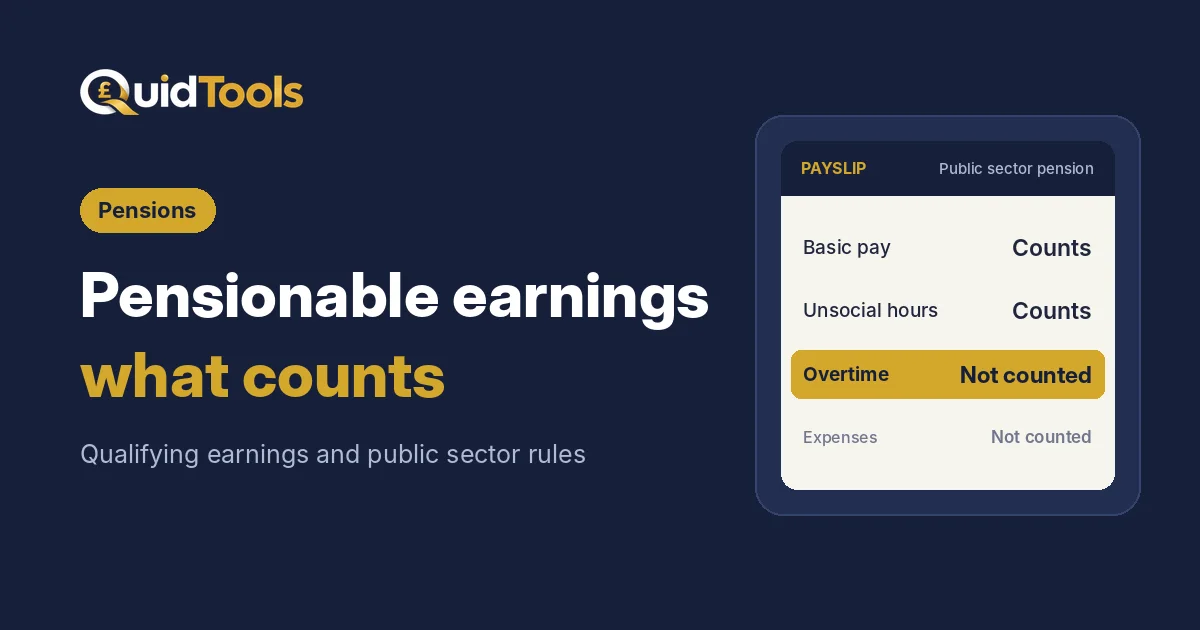
Your payslip shows one figure for pay and a different one for pension, and you want to know why the pension is worked out on less than you earn. The answer is pensionable earnings: the part of your pay your pension scheme counts. In a standard workplace pension it is usually your pay between £6,240 and £50,270 a year. In public sector schemes it is your basic pay plus some allowances, but usually not overtime.
Qualifying earnings: the auto-enrolment minimum
If your employer enrolled you automatically, the law sets the minimum it must pay on: qualifying earnings, your pay between £6,240 and £50,270 a year in 2026/27. It includes salary, wages, overtime, bonuses, commission and statutory sick, maternity, paternity and adoption pay. The minimum is 8% of that band in total, with at least 3% from your employer.
Employers are allowed to use a different definition if it pays at least as much overall. Many use basic salary instead, with no lower limit. That is why two jobs both offering “5%” can put very different amounts into your pension.
Example: £35,000 with a 5% pension
| Basis | Pay counted | 5% from you a year | Plus 3% from employer |
|---|---|---|---|
| Qualifying earnings | £28,760 | £1,438 | £863 |
| Full basic salary | £35,000 | £1,750 | £1,050 |
The full-salary scheme puts £499 a year more into your pension, the £6,240 below the band at 8%. Above £50,270, qualifying earnings stop, so higher earners on that basis get nothing extra on pay above the limit.
You are enrolled automatically if you are 22 or over, under State Pension age and earn more than £10,000 a year. Below that you can ask to join.
Pensionable pay in public sector schemes
Public sector schemes each define pensionable pay in their own rules. It sets three things: what you pay in, what your employer pays, and how much pension you build. In most of them it also sets your contribution rate.
| Scheme | Counts | Doesn’t count |
|---|---|---|
| NHS Pension | Basic pay, High Cost Area Supplement, unsocial hours payments, on-call, extra hours at plain time for part-timers | Overtime at time and a half or double time, expenses |
| Civil Service alpha (prison officers) | Basic pay, unsocial hours allowance or Required Hours Addition | Payment Plus, on-call payments, most committed hours, market supplements |
| Teachers’ Pension | Salary, TLR and SEN allowances | Payments the school doesn’t treat as salary, such as some one-off payments |
| Police Pension | Basic pay | Overtime |
| Local Government Pension Scheme | All pay, including overtime | Expenses |
What that means in practice
- NHS Band 5 with nights and overtime. With 15 hours of nights and 8 hours of overtime a month, gross pay is £38,651 but pensionable pay is £35,922. The night enhancements count; the overtime doesn’t. The 9.8% contribution is charged on £35,922.
- Prison officer on 41 hours with Payment Plus. Gross pay is £42,094, but pensionable pay is £34,928: basic pay plus the 20% unsocial hours allowance. See the Payment Plus calculator.
- Teacher on M6 with a TLR2. Salary and TLR both count, so pensionable pay is £50,591 and the rate is 9.9%.
Why pensionable pay can change your contribution rate
In the NHS, Teachers’, police, fire and civil service schemes, your rate depends on which tier your actual pensionable pay falls in, and the rate applies to all of it. A small rise that crosses a tier line can cost more in pension than it adds in pay. Our posts on NHS pension contribution rates, police pension rates and firefighter pension rates show where each line falls. Overtime that isn’t pensionable never pushes you into a higher tier.
How to find your pensionable pay
- Check your payslip. Some show pensionable pay as its own line. If not, divide the pension deduction by your contribution rate: a £90 deduction at 5% means £1,800 of pensionable pay that month.
- Read your scheme’s rules or member guide. Public sector schemes publish what counts. Workplace pensions say whether they use qualifying earnings or basic pay.
- Ask payroll or HR if the pay counted looks lower than you expect, especially after a pay rise or a change in hours.
Getting more of your pay counted
If your employer pays on qualifying earnings, ask whether it offers a full-salary basis or will match extra contributions: see employer pension matching. In the public sector, the parts that don’t count can still be saved through additional voluntary contributions. When comparing job offers, check the basis as well as the percentage, using the compare job offers calculator.
This is general information for 2026/27. Scheme rules are summarised; your scheme’s own rules decide what counts. Examples use the QuidTools NHS, prison and teacher pay calculators for England.
Sources
Common questions
What are pensionable earnings?
The part of your pay that your pension is worked out on: both what you and your employer pay in, and, in a defined benefit scheme, the pension you build up. Each scheme sets its own definition, so overtime, bonuses and allowances may or may not count.
What are qualifying earnings?
The band of pay that auto-enrolment minimum contributions are based on. In 2026/27 it is pay between £6,240 and £50,270 a year, including salary, overtime, bonuses, commission and statutory sick, maternity and paternity pay.
Is overtime pensionable?
In a workplace pension that uses qualifying earnings, yes. In most public sector schemes, no: NHS overtime, police overtime and prison Payment Plus are not pensionable. The Local Government Pension Scheme is the exception, where overtime does count.
Is a bonus pensionable?
It depends on the scheme. Bonuses count towards qualifying earnings for auto-enrolment, but many employers pay pension on basic salary only. Check your scheme rules or your payslip, where the pension deduction shows what it was worked out on.
Why does pensionable pay matter if I am not retiring soon?
It decides how much goes into your pension every month, including the employer’s share, and in public sector schemes it also sets your contribution rate. A higher pensionable pay means more pension later, and sometimes a higher deduction now.