
Umbrella company take-home pay 2026/27: what you really keep
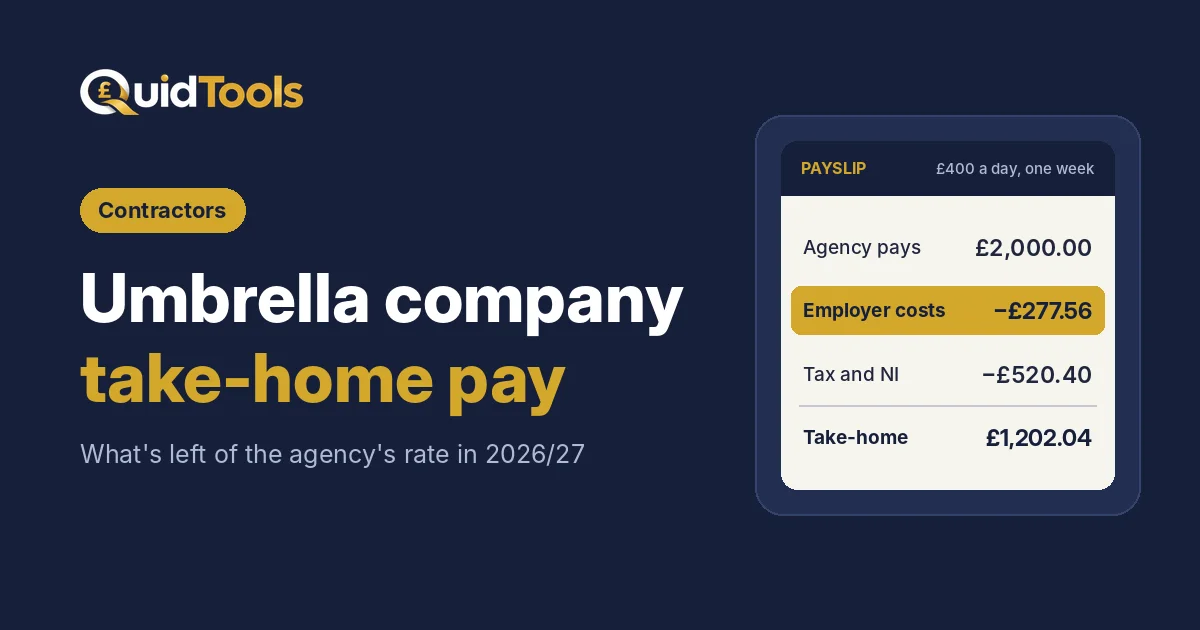
The agency said £400 a day, you worked a full week, and the payslip says £1,202. Nothing has gone wrong. Through an umbrella company, the rate the agency pays is not your salary: the umbrella’s fee, employer National Insurance and the Apprenticeship Levy come out first, then normal tax and NI. On £400 a day you keep about 60%, and across most contract rates it is between 53% and 73%.
A week at £400 a day, line by line
An umbrella payslip comes in two halves. The first, often called the reconciliation or company income statement, turns the agency’s payment into your gross pay:
| From the assignment rate | Amount |
|---|---|
| Paid by the agency (5 days at £400) | £2,000.00 |
| Umbrella margin | −£25.00 |
| Employer National Insurance (15% above £96.15 a week) | −£243.94 |
| Apprenticeship Levy (0.5%) | −£8.61 |
| Your gross pay | £1,722.44 |
The second half is an ordinary payslip. Gross pay of £1,722.44 is split into basic pay of about £1,536.94 and holiday pay of £185.51 if your holiday is paid as you go. Then tax and NI come off as they would for any employee on a salary of about £89,567:
| Your payslip, tax code 1257L | Amount |
|---|---|
| Gross pay | £1,722.44 |
| Income Tax | −£447.29 |
| Employee National Insurance | −£73.11 |
| Take-home | £1,202.04 |
The tax line assumes every week is like this one. In weeks you don’t work you are paid nothing, so with a normal cumulative tax code your tax in working weeks evens out over the year. Pension and student loan deductions, if you have them, come off gross pay too.
Take-home at common day rates
A year of 220 working days with a £25 weekly margin, no pension and no student loan, in 2026/27:
| Day rate | Paid to umbrella | Gross pay | Take-home a year | A month | Kept |
|---|---|---|---|---|---|
| £150 | £33,000 | £28,268 | £23,873 | £1,989 | 72% |
| £200 | £44,000 | £37,792 | £30,730 | £2,561 | 70% |
| £250 | £55,000 | £47,316 | £37,587 | £3,132 | 68% |
| £300 | £66,000 | £56,840 | £43,524 | £3,627 | 66% |
| £350 | £77,000 | £66,364 | £49,048 | £4,087 | 64% |
| £400 | £88,000 | £75,887 | £54,572 | £4,548 | 62% |
| £500 | £110,000 | £94,935 | £65,620 | £5,468 | 60% |
| £600 | £132,000 | £113,983 | £73,871 | £6,156 | 56% |
| £700 | £154,000 | £133,030 | £82,292 | £6,858 | 53% |
The gross pay column is the useful one when you compare with a permanent job. £250 a day for 220 days sounds like £55,000, but it pays like a salary of £47,316, with holiday pay already inside it. Above about £530 a day the share you keep drops faster, because gross pay passes £100,000 and the Personal Allowance starts to go. The day rate guide has a page for each rate.
Hourly rates: agency nurses, teachers, drivers and support staff
Many umbrella workers are paid by the hour. This assumes 37.5 hours a week for 46 working weeks, so the year’s 5.6 weeks of holiday is paid from the rate:
| Umbrella rate | Gross per hour worked | Take-home per hour | Take-home a month | Kept |
|---|---|---|---|---|
| £18.00 | £15.38 | £13.12 | £1,886 | 73% |
| £20.00 | £17.12 | £14.36 | £2,065 | 72% |
| £25.00 | £21.44 | £17.48 | £2,513 | 70% |
| £30.00 | £25.77 | £20.60 | £2,961 | 69% |
| £35.00 | £30.10 | £23.58 | £3,390 | 67% |
There is a floor. At £16.00 an hour, once employer costs and holiday pay are set aside, basic pay works out at about £12.18 an hour, under the £12.71 National Living Wage. On these assumptions about £17.00 an hour is the lowest umbrella rate that covers the minimum wage, so if you are offered less, ask the agency for the Key Information Document and check how your pay is worked out.
Why employer National Insurance comes out of your rate
This is the line people object to most. A permanent employer pays employer NI on top of your salary, so you never see it. With an umbrella, the agency’s rate is meant to cover your whole cost of employment: margin, employer NI, employer pension, holiday pay and the levy. That’s why umbrella rates are quoted higher than PAYE rates for the same job.
It becomes a problem when the agency quotes a rate that was never uplifted to cover those costs. Your Key Information Document, which the agency must give you before you start, should show the assignment rate, every deduction from it and your expected gross pay. Compare those with your first payslip. The rule is simple: employer NI comes out of the assignment rate, never off your gross pay.
Holiday pay: added to each payslip or held back
You are entitled to 5.6 weeks’ paid holiday a year, and the umbrella funds it from your rate. For irregular-hours and part-year workers it can be “rolled up” at 12.07% and added to each payslip, as in the example above. Otherwise the umbrella holds it and pays you when you take leave.
If yours is held back, check the balance on each payslip and book time off. When you leave, any built-up holiday should be paid out with your final pay. See unused holiday pay when leaving.
Pensions through an umbrella
The umbrella must auto-enrol you if you earn over £10,000 a year. At the minimum, the employer pays 3% and you pay 5% of earnings between £6,240 and £50,270, and the employer’s 3% also comes out of the assignment rate. On £250 a day that costs about £2,350 of take-home a year and puts about £3,200 into your pension.
Many umbrellas offer salary sacrifice instead, which saves tax and NI, and some pass the employer NI saving on. On £250 a day, sacrificing 5% of gross pay cuts take-home from £37,587 to £35,884 but puts £2,366 into the pension. Ask which method yours uses.
Signs your umbrella is taking too much
HMRC warns about umbrellas running tax avoidance schemes, where you can end up owing the tax yourself. Watch for:
- Promises of 80% or 90% take-home. Every compliant umbrella pays the same tax and NI, so take-home only differs by the margin. Nothing in the tables above gets near 80% on a full year’s work.
- Being paid in two parts. One payment matching your payslip and a second “loan”, “bonus” or “investment” payment is the classic disguised remuneration pattern.
- Basic pay at minimum wage. A payslip showing the £12.71 National Living Wage when your rate supports much more, with the rest paid elsewhere.
- A changing employer name or PAYE reference. Being moved between umbrellas you didn’t choose, often small “mini umbrellas”.
- Deductions lumped together. One “company costs” figure with no breakdown can hide extra skimming from the rate.
Check your tax and NI against your personal tax account, and use HMRC’s own umbrella pay tool to compare. Accreditation from a trade body is a useful check but not a guarantee; HMRC never approves umbrella companies.
What changed in April 2026
From 6 April 2026, if an umbrella fails to pay over the PAYE and NI it took from your pay, HMRC can collect it from the recruitment agency instead, or in some cases the end client. It doesn’t change your take-home, but agencies have tightened their lists of approved umbrellas, so you may be asked to switch. The government also plans to bring umbrella companies under the same regulation as employment agencies; GOV.UK gives no start date yet.
Employer NI has been 15% on pay above £5,000 a year since April 2025, up from 13.8% above £9,100, which is a large part of why umbrella take-home fell that year at the same rate.
Before you sign with an umbrella
Get the assignment rate, the weekly margin and an illustration of your gross and net pay in writing, and check them against the tables here or the calculator. If the gross pay matches and the margin is in line, the umbrella is not costing you more than any other. If you are outside IR35 and paid well, a limited company may leave you more; the calculator shows both side by side.
General information for 2026/27 in England, Wales and Northern Ireland, with tax code 1257L, a £25 weekly margin and no pension or student loan unless stated. Scotland has different Income Tax bands. Your umbrella’s own figures may differ slightly because PAYE is worked out pay period by pay period.
Sources
- GOV.UK: Working through an umbrella company
- GOV.UK: Key information document for agency workers paid through umbrella companies
- HMRC: Check your payslip if you work through an umbrella company
- HMRC: Work out pay from an umbrella company
- HMRC: Umbrella company market, changes to Income Tax rules from 6 April 2026
- HMRC: Spot the signs of disguised remuneration tax avoidance schemes
- GOV.UK: Income Tax rates and Personal Allowances
- GOV.UK: National Insurance rates and categories
Common questions
What percentage do you take home through an umbrella company?
On a full year's work in 2026/27, roughly 53% to 73% of the assignment rate, with a £25 weekly margin. The higher your rate, the lower the share, because more of it is taxed at 40%. At £400 a day it is about 60%. An umbrella promising 80% or more is a warning sign of tax avoidance.
What is a reasonable umbrella company margin?
Margins of about £15 to £30 a week are commonly quoted, usually as a fixed weekly or monthly fee rather than a percentage. Check whether the quote includes everything: some umbrellas add set-up, same-day payment or admin fees on top.
Can an umbrella company take employer National Insurance from my pay?
Not from your gross pay. Employer NI, employer pension and the Apprenticeship Levy are paid out of the assignment rate before your gross pay is worked out, and GOV.UK says the NI and pension taken off your gross pay should only be the employee contributions. If you see employer NI below your gross pay line, query it.
Do umbrella company workers get sick pay and holiday?
Yes. The umbrella is your employer, so you get statutory holiday, Statutory Sick Pay, Statutory Maternity Pay and other employee rights from it, provided you meet the usual conditions. Holiday pay is funded from your assignment rate, either added to each payslip or held until you take leave.
Can I claim travel expenses through an umbrella company?
Usually not. Since 2016, tax relief on home-to-work travel is blocked for most umbrella and agency workers because they are under the supervision, direction or control of the client. An umbrella offering big tax-free expense payments is a reason to ask questions.
Is umbrella or agency PAYE better?
It depends on the rates offered. Umbrella rates are higher because they have to cover employer costs. On our figures, £25.00 an hour through an umbrella gives gross pay of about £21.44 an hour including holiday pay, so it matches an agency PAYE rate of about £19.13 plus holiday pay. Compare offers on that basis.