
Employer's National Insurance 2026/27: what it costs at every salary
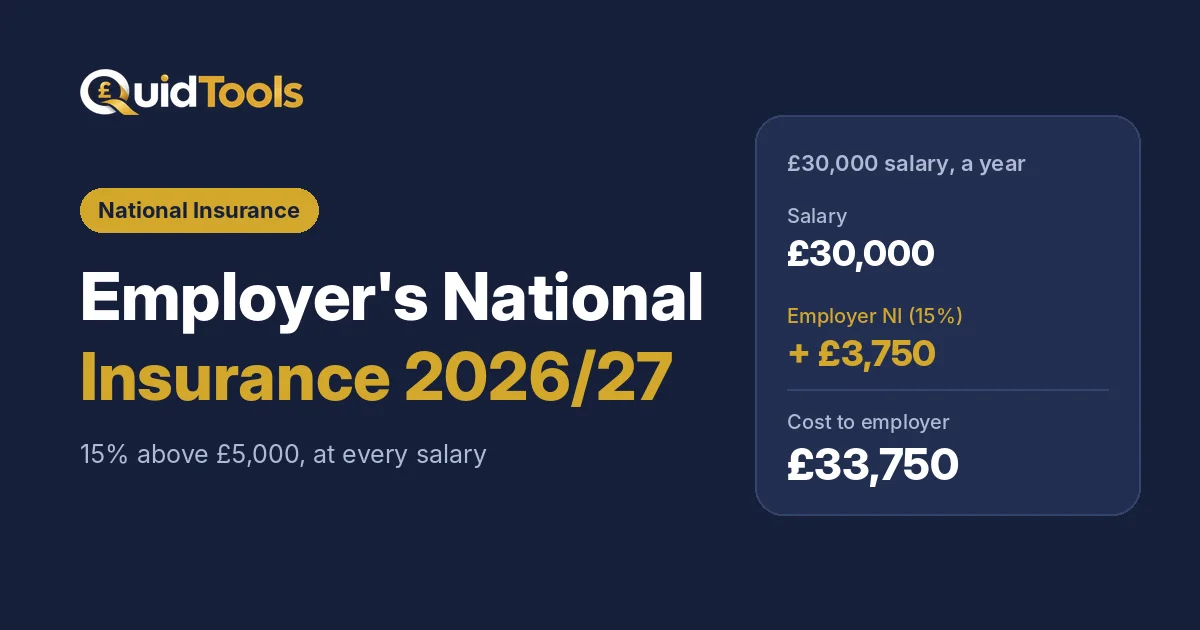
You are hiring your first employee, pricing a job offer, or wondering why your employer says you cost more than your salary. Employer’s National Insurance is the reason. For 2026/27 an employer pays 15% on everything an employee earns above £5,000 a year, on top of their pay. On a £30,000 salary that is £3,750 a year, or £312.50 a month.
Employer National Insurance at every salary
| Salary | Employer NI a year | Employer NI a month | Total cost to employer | Employee’s own NI a year |
|---|---|---|---|---|
| £12,570 | £1,136 | £94.63 | £13,706 | £0 |
| £20,000 | £2,250 | £187.50 | £22,250 | £594 |
| £25,000 | £3,000 | £250.00 | £28,000 | £994 |
| £30,000 | £3,750 | £312.50 | £33,750 | £1,394 |
| £40,000 | £5,250 | £437.50 | £45,250 | £2,194 |
| £50,000 | £6,750 | £562.50 | £56,750 | £2,994 |
| £60,000 | £8,250 | £687.50 | £68,250 | £3,211 |
| £80,000 | £11,250 | £937.50 | £91,250 | £3,611 |
| £100,000 | £14,250 | £1,187.50 | £114,250 | £4,011 |
Rates for 2026/27, before the Employment Allowance, for an employee aged 21 or over who is not an apprentice. The total cost leaves out pension contributions: under auto-enrolment the employer adds at least 3% of qualifying earnings on top.
Two things stand out. The employer starts paying at £5,000, well below the £12,570 where the employee starts, so even part-time and low-paid jobs carry a cost. And there is no upper limit for the employer, while the employee’s rate drops from 8% to 2% above £50,270. On a £100,000 salary the employer pays £14,250, more than three times the employee’s £4,011.
How the calculation works, step by step
Take a £30,000 salary paid monthly:
- Monthly pay is £2,500.00.
- The monthly threshold set by HMRC is £417.
- Pay above the threshold is £2,083.00.
- 15% of that is £312.45, paid to HMRC with the month’s PAYE.
Payroll works this out pay period by pay period, not on the year as a whole. For most employees each month stands alone, so a month with overtime or a bonus costs the employer 15% of the extra, and a month below the threshold costs nothing. If this employee earned £3,200 in one month with overtime, that month’s employer NI would be £417.45. Company directors are the exception: their National Insurance is worked out on their earnings for the whole year.
Employer National Insurance is reported and paid through PAYE, normally by the 22nd of the following month if paid electronically.
The Employment Allowance: up to £10,500 off the bill
Most employers can knock up to £10,500 a year off their employer National Insurance. You claim it once through your payroll software and it comes off each payment until it is used up or the tax year ends.
For a small business it can wipe out most of the bill. Three employees on £30,000 each create £11,250 of employer National Insurance. Take off the £10,500 allowance and the business pays £750 for the whole year.
You cannot claim it if:
- you are a limited company and the only employee paid above the secondary threshold is a director, which rules out most one-person companies,
- you employ someone for personal, household or care work (care and support workers are an exception),
- you are a public body or do more than half your work in the public sector, other than charities.
When the employer pays 0%
For some employees the employer pays nothing on earnings up to £50,270 a year, then 15% above it:
- Under 21. Payroll uses category letter M.
- Apprentices under 25 on an approved apprenticeship, letter H.
- Armed forces veterans in the first year of their first civilian job after leaving, letter V.
- Freeport and Investment Zone employees for their first three years, up to a lower limit of £25,000.
A 19-year-old on £25,000 would normally cost £3,000 a year in employer National Insurance. Under category M it costs nothing, which is one reason employers take on younger staff and apprentices.
Salary sacrifice cuts it too
When an employee gives up salary in exchange for a pension contribution, electric car or cycle to work scheme, neither side pays National Insurance on the amount given up. An employee sacrificing £2,000 a year into their pension saves the employer £300, and some employers pass that saving into the pension. From April 2029 only the first £2,000 a year of pension salary sacrifice will be free of National Insurance. See salary sacrifice explained.
Benefits in kind: Class 1A
Employers also pay 15% Class 1A National Insurance on most taxable benefits, such as a company car or private medical insurance, based on their taxable value. It is paid once a year, by 22 July after the tax year ends, after the P11D figures are worked out.
What this means if you are employing someone
Budget for salary plus about 15% of the salary above £5,000, plus at least 3% pension, then take off the Employment Allowance if you can claim it. For one employee on £30,000 that is about £33,750 before pension. If you are the employee, you never see this money, but it is part of what your job costs and part of why employers like salary sacrifice.
To see what the employee keeps, use the take-home pay calculator. For the employee’s side of National Insurance, see how to read your payslip, and for running a company, director salary vs dividends.
Sources
Common questions
What is the employer National Insurance rate for 2026/27?
15% on each employee's earnings above £5,000 a year (£417 a month). There is no upper limit, so the employer keeps paying 15% on every pound above the threshold.
How much employer National Insurance is paid on a £30,000 salary?
£3,750 a year, or £312.50 a month. That is 15% of the £25,000 above the £5,000 threshold.
Does employer National Insurance come out of my pay?
No. It is paid by your employer on top of your salary and does not appear as a deduction on your payslip. Only employee National Insurance is taken from your pay.
Who can claim the Employment Allowance?
Most employers with employer National Insurance to pay can claim up to £10,500 a year off their bill. A limited company whose only employee paid above the threshold is a director cannot claim it, and neither can most public bodies.
Do employers pay National Insurance for under-21s?
Not on earnings up to £50,270 a year. The same applies to apprentices under 25. Above that, the normal 15% applies.