Salary sacrifice pensions: what you really save, the catches, and the 2029 change
If your employer has ever offered to switch your pension to “salary sacrifice”, you might have wondered whether it’s a perk or a catch. The name doesn’t help, since nobody likes the sound of sacrificing part of their salary.
In most cases it’s a perk. You end up with the same amount going into your pension and slightly more in your pocket. But it isn’t right for everyone, and the rules are changing in 2029.
How it works
Normally, your pension contribution comes out of your pay. With salary sacrifice, you agree to a lower salary instead, and your employer pays the difference straight into your pension. The money ends up in the same place. What changes is the order things happen in.
Because your official salary is lower, you pay less Income Tax and less National Insurance. Ordinary pension contributions only save you tax. Your employer pays less National Insurance too, at 15%.
What it actually saves
Workplace pensions are taken in one of three ways, and you can usually tell which from your payslip. To compare them fairly, I put the same person through our calculator three times: £35,000 salary, 5% going into the pension, nothing else different.
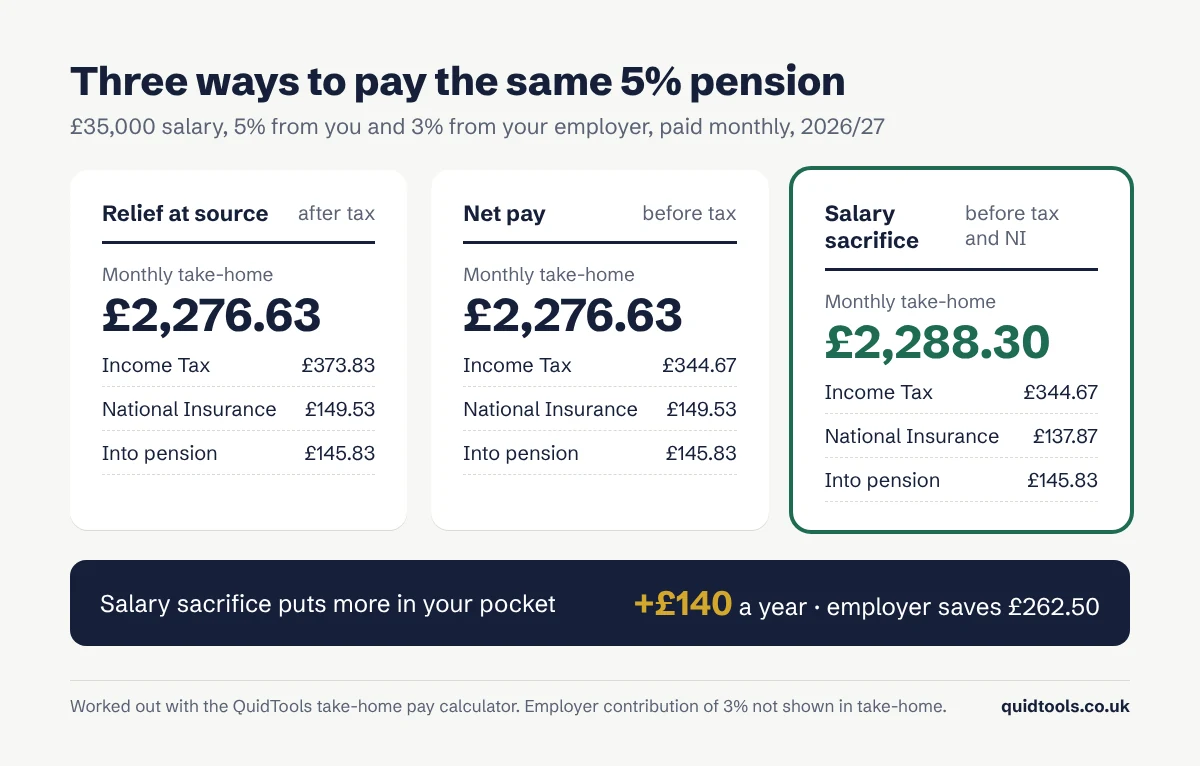
Relief at source and net pay come out exactly the same. They just get you the tax relief in different ways. Salary sacrifice comes out £11.67 a month ahead, which is £140 a year, because you’re no longer paying 8% National Insurance on the money going into your pension.
That’s not life-changing on a 5% contribution. But it scales: at 10% it’s twice as much, and higher-rate taxpayers save 2% NI on top of their 40% tax relief.
The bigger saving is your employer’s. In this example they save £262.50 a year in National Insurance. Some employers keep that, and some add some or all of it to your pension. It’s always worth asking which yours does.
The downsides people don’t mention
Because your contractual salary is lower, anything worked out from your salary can be affected. Most of these are small, but it’s worth knowing:
- Mortgages. Some lenders look at your salary after the sacrifice when working out how much you can borrow. Many will accept the pre-sacrifice figure if you ask, but not all.
- Statutory pay. Statutory Maternity Pay and sick pay are based on your actual earnings. If a sacrifice takes your pay below the lower earnings limit of £129 a week, you could lose them. That only affects people on low pay.
- Life cover and pay rises. Death-in-service benefits and percentage pay rises are usually based on your pre-sacrifice salary, but check your employer’s scheme.
- The minimum wage. A sacrifice can’t take your pay below the National Living Wage, so it isn’t open to everyone on low pay.
The 2029 change
From April 2029, only the first £2,000 a year you sacrifice into a pension will be free of National Insurance. Anything above that will be treated like normal pay for NI, though it will still get the Income Tax saving.
For our £35,000 example, 5% is £1,750 a year, so nothing changes. If you sacrifice more than £2,000, you’ll lose part of the NI saving from 2029, but salary sacrifice will still be at least as good as a normal pension contribution. It just won’t be quite as much better.
Should you do it?
If your employer offers it and you’re comfortably above the minimum wage, it’s usually a good idea. Ask two questions first: does your employer pass on any of its NI saving, and is a mortgage application coming up soon? If the answers are “yes” and “no”, it’s an easy decision.
And if you earn between £100,000 and £125,140, salary sacrifice is one of the best ways out of the 60% tax trap.
See the difference on your own pay
In our take-home pay calculator, add a pension and switch the arrangement between “Relief at source”, “Workplace, whole salary” (that’s net pay) and “Salary sacrifice” to see exactly what changes on your payslip. To see what those contributions could grow to, try the pension calculator.
This is general information, not financial advice. Figures use 2026/27 rates for England, Wales and Northern Ireland.