How much can I borrow for a mortgage? Income multiples, affordability and deposits explained
Before you start looking at houses, it helps to know roughly what you can actually afford, because nothing’s more deflating than falling for a place and then finding out the bank won’t lend you enough. The figure lenders arrive at isn’t a mystery, though. It comes from a few simple things, and you can estimate it pretty accurately yourself.
Start with your income multiple
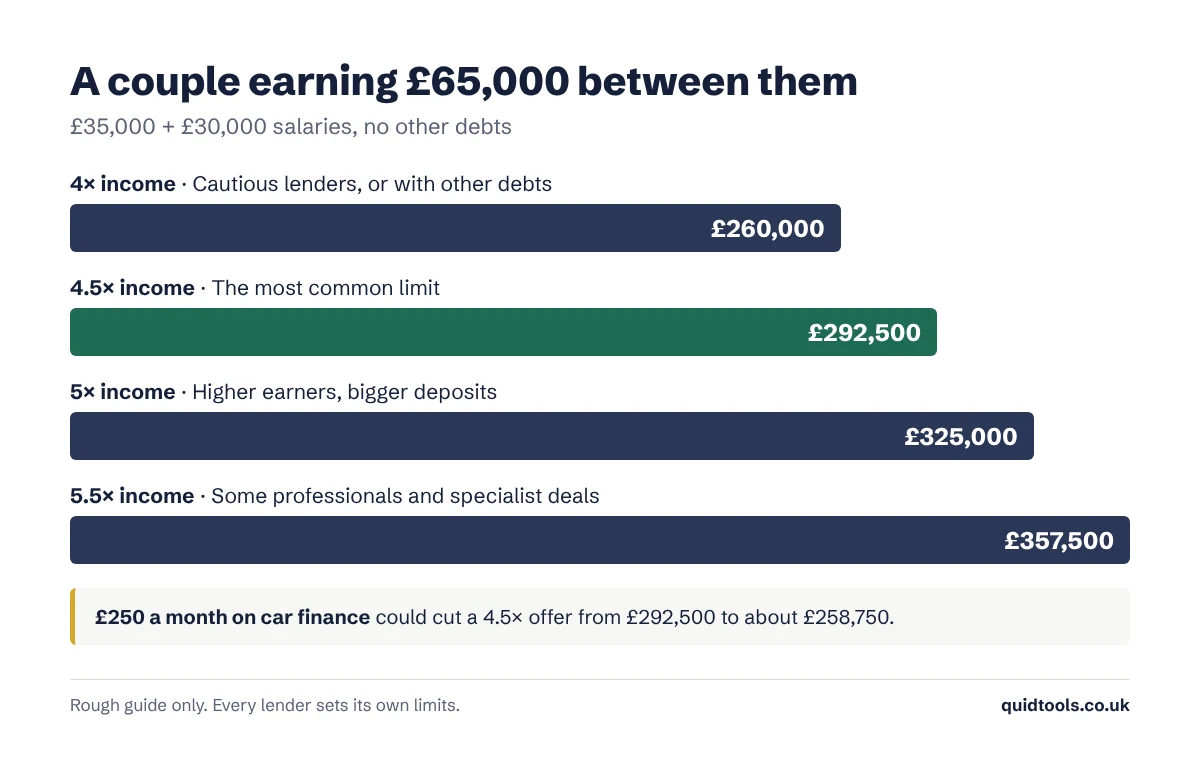
Most UK lenders will lend somewhere between four and four-and-a-half times your annual income, or your combined income if you’re buying with someone. A few go to five or even five-and-a-half times for higher earners, people in certain professions, or buyers with a big deposit.
So for a couple earning £35,000 and £30,000, the starting point looks like this:
“Income” usually means your basic salary. Lenders will often count some overtime, bonus or commission, but usually only part of it, and only if you can show it’s regular. If you’re self-employed, expect them to look at your last two or three years of tax returns.
Then the affordability check
The multiple is a ceiling, not a promise. Lenders also look at what you spend each month to check you could still make the payments if rates went up. A few things knock the figure down more than people expect:
- Existing debts. Car finance, personal loans and credit card balances come straight off what you can afford. In the example above, £250 a month on a car could cost the couple about £34,000 of borrowing.
- Childcare. Nursery fees count as a big fixed cost.
- Student loans. They’re not counted as debt, but the monthly repayment reduces your take-home pay, which lenders do look at.
- Your credit file. Missed payments or lots of recent credit applications can mean lower offers or higher rates.
If you’re planning to buy in the next year, it’s worth clearing small debts and avoiding new credit applications for a few months beforehand.
The deposit decides the price you can pay
What you can borrow plus your deposit gives you your budget. If our couple can borrow £292,500 and have saved £30,000, they’re looking at homes up to about £322,500.
The size of your deposit matters for another reason too. Lenders price mortgages in bands by loan-to-value, the share of the price you’re borrowing. The best rates usually start at 60% or 75% LTV. With a 10% deposit you’ll typically pay a noticeably higher rate than with 25%.
Don’t forget the costs on top
Stamp duty can take a chunk out of your budget, though first-time buyers in England and Northern Ireland pay nothing on the first £300,000 and 5% on the part between £300,000 and £500,000. Our couple buying at £322,500 as first-time buyers would pay £1,125. If either of them had owned a home before, it would be £6,125.
Add solicitor’s fees, a survey and possibly a lender’s arrangement fee, and it’s sensible to keep a few thousand pounds aside on top of your deposit.
Just because you can borrow it doesn’t mean you should
At today’s rates of around 5.9%, borrowing £292,500 over 30 years costs about £1,735 a month. That’s fine for some households and a real stretch for others. Before you take the maximum, check the monthly payment against your actual budget, not the lender’s, and think about what happens when your fixed rate ends and you have to remortgage.
A longer term lowers the monthly payment but means paying far more interest overall. Over 25 years instead of 30, that same loan would cost about £1,867 a month, but you’d be mortgage-free five years sooner.
Get an agreement in principle
Once you have a rough figure, an agreement in principle (sometimes called a decision in principle) from a lender or broker tells you what they’d actually be prepared to lend, usually with only a soft credit check. Estate agents often ask for one before they’ll take an offer seriously.
Work out your own figure
Our mortgage affordability calculator takes your income, debts and deposit and shows what you could borrow at different multiples, the price range that gives you, the monthly payment and the stamp duty. Then use the stamp duty calculator and the mortgage calculator to check the numbers on a specific home.
This is general information, not mortgage advice. Every lender sets its own criteria, and the figures here are a rough guide. A mortgage broker can tell you what you’re likely to be offered.