Overpay your mortgage or save the money? A fair comparison with real numbers
If you’ve got a bit of money left over at the end of each month, you’ll eventually face this question. Do you throw it at the mortgage and be debt-free sooner, or save it somewhere you can get at it?
People feel strongly about this one. Some can’t stand owing money and want the mortgage gone. Others hate the idea of money locked up in bricks. The numbers do have an answer, but it’s closer than either camp usually admits, and the right choice depends on a few things the numbers don’t capture.
The simple rule
Overpaying your mortgage earns you, in effect, your mortgage interest rate, guaranteed and tax-free. Every pound you pay off is a pound you stop being charged interest on.
So the question is really: can you earn more than your mortgage rate on savings, after tax? If your mortgage costs 5% and the best savings account pays 4.5%, overpaying wins. If your mortgage is on 2% and savings pay 4.5%, you’re better off saving and letting the cheap mortgage run.
Tax matters here. In a cash ISA, savings interest is tax-free. Outside one, once you’ve used your personal savings allowance, a basic-rate taxpayer currently loses 20% of the interest, and 24% from April 2027. That 4.5% becomes 3.6%, or 3.42% after the change.
Running the numbers
To make it concrete, I took a £150,000 mortgage at 5% over 20 years. The normal payment is £989.93 a month. Then I compared two people with an extra £200 a month.
The first overpays by £200 every month. They clear the mortgage five years early and save £24,397 in interest. For the last five years they put their whole old mortgage payment, £1,190 a month, into savings instead.
The second puts £200 a month into a cash ISA earning 4.5%, tax-free, and pays the mortgage as normal.
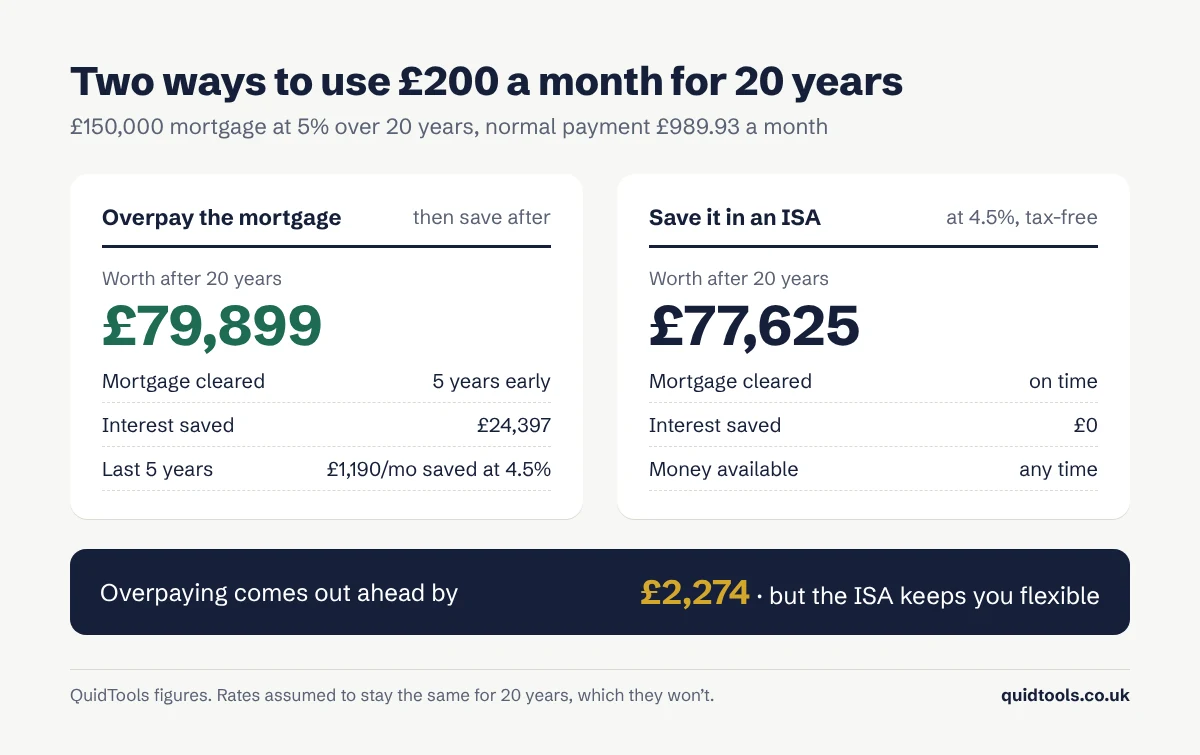
After 20 years, overpaying comes out about £2,300 ahead. That’s a win, but a small one for 20 years of discipline. If the savings rate had been higher than the mortgage rate, it would have gone the other way.
What the numbers don’t tell you
Money in your house is hard to get back. This is the big one. Once you’ve overpaid, you usually can’t take that money out again without remortgaging. If you lose your job, the boiler dies or the car fails its MOT, savings help and an overpaid mortgage doesn’t. Your monthly payment stays the same either way.
Rates won’t stay put. Most people remortgage every two or five years, so the comparison changes each time. When mortgage rates are high, overpaying looks better. When they fall, saving often wins.
A smaller loan can get you a better deal. Overpaying reduces your loan-to-value, and crossing a threshold like 75% or 60% can unlock a cheaper rate at your next remortgage. That’s a bonus the simple maths above doesn’t include.
Peace of mind counts. If being mortgage-free by 55 matters to you, that’s a perfectly good reason to overpay, even if it isn’t the strictly optimal one.
The order I’d do things in
- Clear expensive debt first. Credit cards and overdrafts charge far more than any mortgage.
- Build an emergency fund. Three to six months of essential spending, in easy-access savings.
- Take the full employer pension match. If your employer adds more when you pay more, that beats any mortgage overpayment.
- Then compare the rates. If your mortgage rate is higher than what you can earn after tax, overpay. If it’s lower, save or invest.
If you do overpay
Check your mortgage offer first. Most fixed and tracker deals let you overpay up to 10% of the balance each year without a charge. Go over that and you may pay an early repayment charge, often 1% to 5% of the extra.
Tell your lender whether you want to shorten the term or lower your monthly payment. Shortening the term saves more interest. Lowering the payment gives you more breathing room each month.
It’s also worth asking about an offset mortgage if you’re remortgaging. Your savings sit in a linked account, reducing the interest you pay, but you can still get at them. It’s a bit of both.
Try it with your own mortgage
Our mortgage overpayment calculator shows exactly how much interest you’d save and how much sooner you’d be mortgage-free, and warns you if you go over the usual 10% limit. To see how the savings route would grow, use the compound interest calculator.
This is general information, not financial advice. The example assumes rates stay the same for 20 years, which they won’t. Check your own mortgage terms before overpaying.