Holiday entitlement for part-time and irregular-hours workers: how much paid leave you get
Holiday entitlement is simple if you work Monday to Friday, nine to five: you get 28 days a year, and that’s that. It gets confusing the moment your hours don’t look like that. Part-time, zero-hours, term-time only, shifts that change every week. These are exactly the jobs where people are most likely to be short-changed, often without anyone meaning to.
Here’s how it works, in plain English.
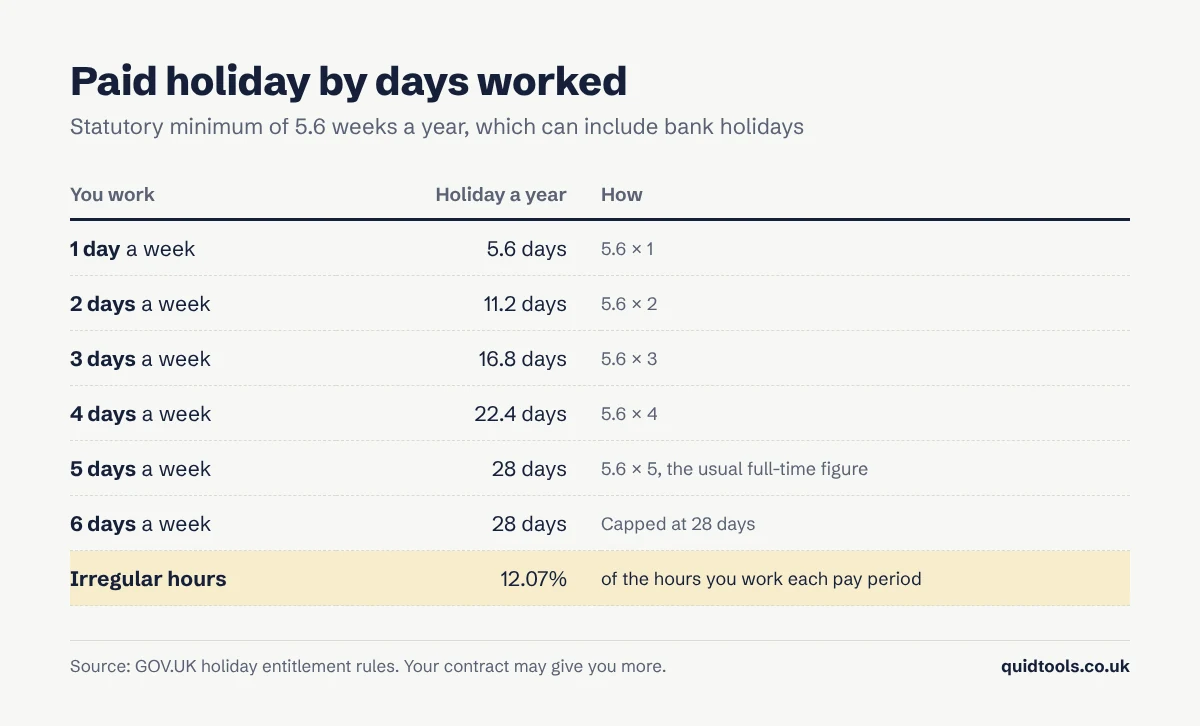
The basic rule: 5.6 weeks
Almost every worker in the UK is entitled to 5.6 weeks of paid holiday a year. That’s the legal minimum. Your contract can give you more, but never less.
The reason it’s written in weeks is that it scales to however much you work. A “week” of holiday means a week of your normal working pattern, whatever that is.
If you work fixed days
Multiply the days you work each week by 5.6. Someone who works three days a week gets 16.8 days. Someone who works four gets 22.4. Full-time on five days is 28. There is a cap at 28 days, so someone working six days a week doesn’t get more than that by law.
If your days are different lengths, it’s fairer to work in hours. Someone doing 20 hours a week over four days gets 5.6 × 20 = 112 hours of paid holiday a year.
Bank holidays
This one surprises people. There’s no legal right to have bank holidays off, or to be paid extra for working them. Employers can count them as part of your 5.6 weeks.
Where it gets unfair is for part-time staff. If bank holidays usually fall on a Monday and you don’t work Mondays, you shouldn’t lose out compared with someone who does. A good employer works out everyone’s holiday in hours or days pro rata and lets part-timers take their share of bank holidays whenever suits them.
If your hours are irregular
Since April 2024 there’s a separate rule for irregular-hours workers (where the hours you work vary from week to week) and part-year workers (like term-time staff). You build up holiday as you go, at 12.07% of the hours you actually work in each pay period.
That odd-looking number is just 5.6 weeks divided by the 46.4 weeks left in a year once those 5.6 weeks are taken off. So if you work 1,000 hours over a year, you’ve earned 120.7 hours of paid holiday.
Employers of irregular-hours and part-year workers can also choose to pay “rolled-up” holiday pay: an extra 12.07% added to your pay every payday, instead of paying you when you actually take time off. If your employer does this, it must show it as a separate line on your payslip. You still have the right to take the time off; it just won’t be paid at the time.
How much you get paid while you’re off
You should get your normal pay for holiday. For people with fixed hours and pay, that’s easy. If your pay varies, it’s an average of what you earned over the last 52 weeks you actually worked, ignoring any weeks you didn’t work.
That average should include regular overtime, commission and certain allowances for the first four weeks of your holiday each year. Plenty of workers are underpaid here, because payroll only uses their basic rate.
Starting or leaving part way through the year
If you start or leave a job part way through the holiday year, you get a proportion of your annual entitlement. When you leave, any holiday you’ve built up but not taken has to be paid in your final pay. If you’ve taken more than you’ve built up, your employer can only take it back from your pay if your contract says so.
Work out your entitlement
Our holiday entitlement calculator covers fixed days, fixed hours, irregular hours and starting or leaving mid-year, using the current rules. If you’re part-time and want to check your pay as well, try the part-time pay calculator.
This is general information, not legal advice. Different rules can apply to agency workers, some sectors and Northern Ireland. If you think you’re being underpaid, Acas offers free, confidential advice.