Redundancy pay explained: what you are legally owed and how much is tax-free
Being told your job is at risk is a horrible moment, and the paperwork that follows usually arrives just when you’re least able to take it in. But it’s worth understanding what you’re owed, because redundancy payouts are often a mix of several things, taxed in different ways, and mistakes do happen.
Here’s what the law guarantees, how it’s worked out, and what you get to keep.
Who gets statutory redundancy pay
You’re entitled to statutory redundancy pay if you’re an employee, you’ve worked for your employer continuously for at least two years, and your job is genuinely disappearing. Some people aren’t covered, including the self-employed and most agency workers.
Two years is the key number. If you’re made redundant a week before your second anniversary, you won’t qualify for the statutory payment, though your employer may still pay something under your contract.
How the amount is worked out
It depends on three things: your age, how many full years you’ve worked there, and your weekly pay. For each full year, you get a set number of weeks’ pay, based on how old you were during that year.
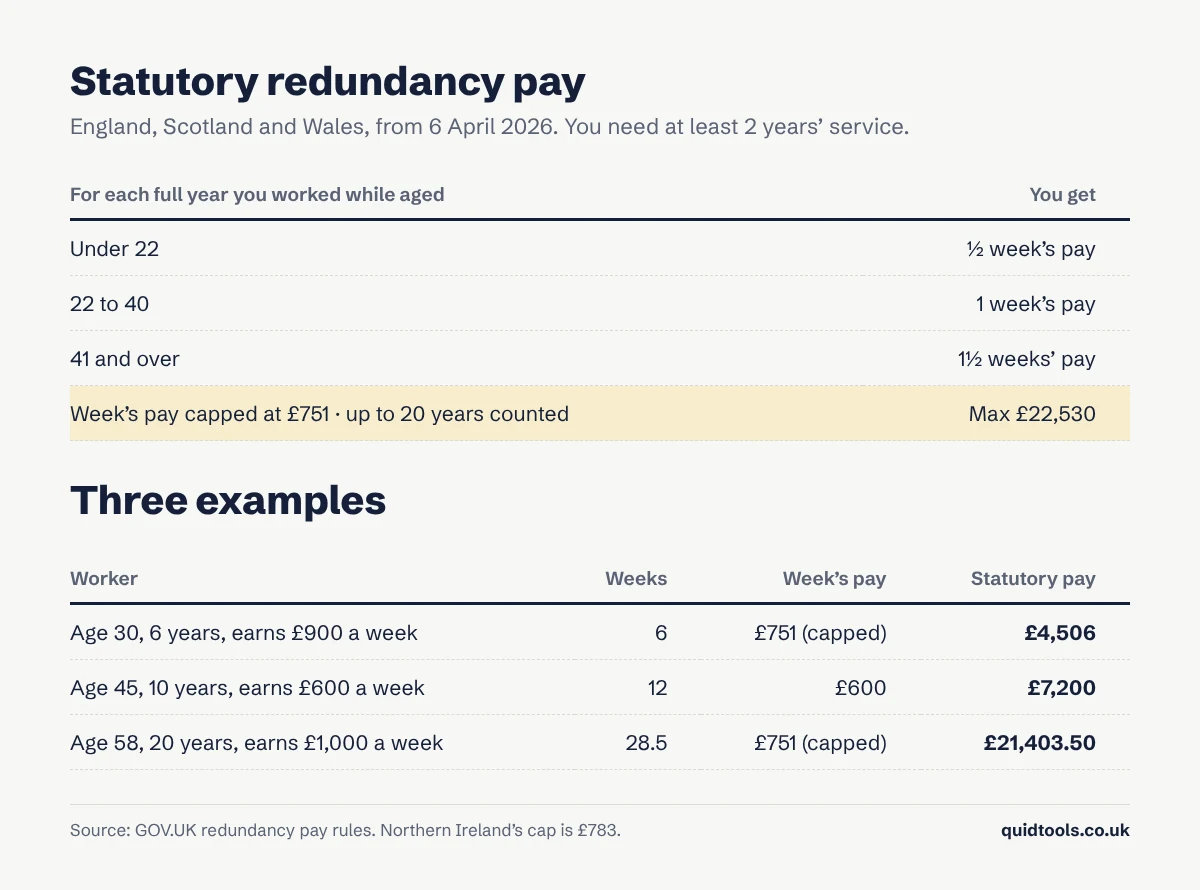
Two limits apply. Only your most recent 20 years count, and a week’s pay is capped at £751, or £783 in Northern Ireland. If you earn more than that, your payment is worked out as if you earned £751. That’s why the maximum statutory payment is £22,530, however senior you are.
Take the second example. At 45 with 10 years’ service, four of those years were at age 41 or over (worth 1½ weeks each, so 6 weeks) and six were at 40 or under (6 weeks). That’s 12 weeks at £600, or £7,200.
Your employer may pay more
Statutory pay is the minimum. Many employers offer an enhanced package, sometimes based on your real salary rather than the capped figure, or with more weeks per year. Check your contract and staff handbook, and look at what’s been paid in previous redundancy rounds. That’s often a good guide to what you can negotiate.
What else you should be paid
Redundancy pay isn’t the only thing you’re owed. Your final pay should also include:
- Notice pay. At least one week’s notice for each year worked, up to 12 weeks, or more if your contract says so. If you’re told not to work your notice, you’ll be paid instead, often called pay in lieu of notice.
- Holiday pay for any leave you’ve built up but not taken.
- Your normal wages up to your leaving date, plus any bonus or commission you’ve already earned.
How much is tax-free
This is where the mix matters. The first £30,000 of a genuine redundancy payment, statutory and enhanced together, is free of Income Tax and National Insurance. Anything above that is taxed but has no employee National Insurance.
Notice pay, holiday pay and your final wages are treated like normal pay. They’re taxed and you pay National Insurance on them, even if they arrive in the same lump sum as your redundancy payment. If your payslip shows tax on what you thought was all redundancy pay, it’s usually because part of it is notice or holiday pay.
A large final payment can also push you onto an emergency tax code at your next job, or take too much tax in one month. Any overpayment comes back to you, either through your new employer’s payroll or from HMRC after the tax year ends.
Your other rights
- Your employer must use a fair way to choose who is made redundant, and consult with you first.
- If there’s a suitable alternative job, they should offer it to you. If you unreasonably turn down a suitable offer, you may lose your redundancy pay.
- You’re entitled to reasonable paid time off to look for work or training during your notice period, if you have two years’ service.
- If your employer goes bust and can’t pay, you can usually claim statutory redundancy pay, notice pay and some holiday pay from the government’s Redundancy Payments Service.
Work out your own figure
Put your age, years of service and weekly pay into our redundancy pay calculator. It works out the statutory amount, applies the weekly cap and shows how much of your payout would be tax-free. To check what your notice and holiday pay will add, the holiday entitlement calculator can help.
This is general information, not legal advice. For help with a redundancy, contact Acas for free, confidential guidance, or speak to a union representative or employment solicitor.