
Prison officer shifts and career progression (2026/27)
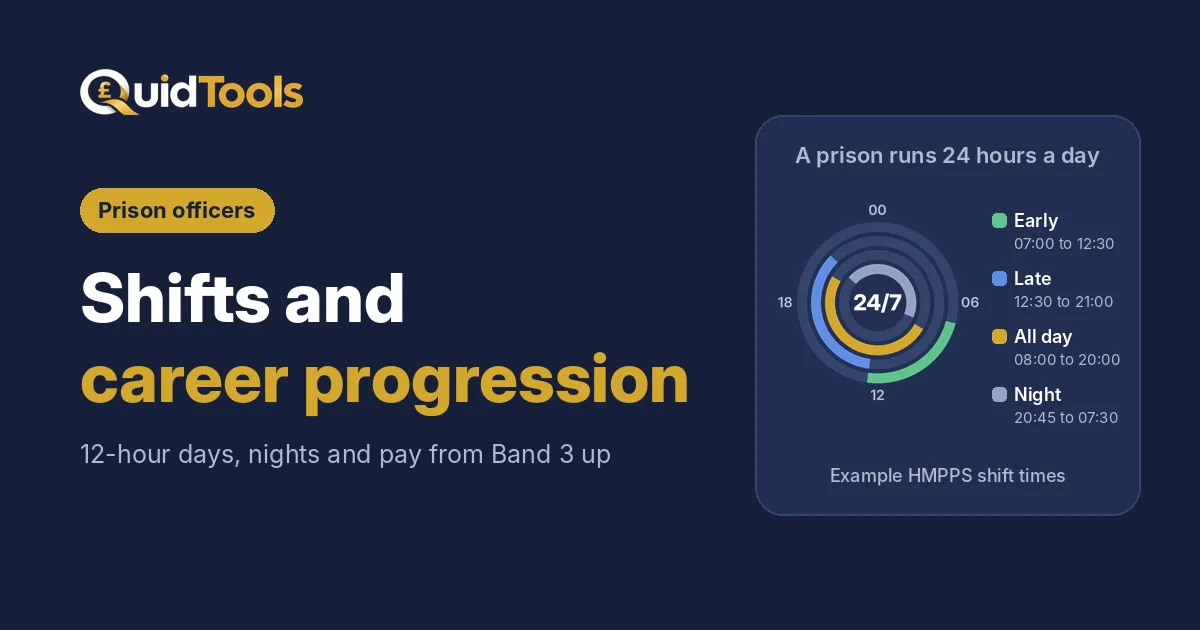
You’ve got a start date as a prison officer and two questions keep coming up: what will the shifts actually be like, and where does the job go from Band 3? Yes, most officers work some 12-hour days. Prisons run around the clock on a rolling pattern of earlies, lates, long all-day shifts and nights. On pay, a new officer starts on £34,928, Band 4 pays £41,328 and a custodial manager starts on £44,900, all on 37 hours nationally from April 2026.
Do prison officers work 12-hour shifts?
Most do, some of the time. Prisons need staff 24 hours a day, so officers work a rolling pattern made of different shift types. HMPPS gives example times like these, and each prison sets its own:
| Shift | Typical start | Typical finish | Length |
|---|---|---|---|
| Early | 7am to 8am | 12:30pm to 1:45pm | About 5 to 6 hours |
| Main | 7am to 8am | 5pm to 6pm | About 9 to 10 hours |
| Late | 12pm to 1:30pm | 8pm to 9:15pm | About 8 hours |
| All day | 7:45am to 8am | 8pm to 9:15pm | About 12 to 13.5 hours |
| Night | 8:45pm | 7:30am to 7:45am | About 11 hours |
The all-day and night shifts are the long ones people mean when they ask about 12-hour shifts. Your pattern will also include weekends and bank holidays. A bank holiday you work is added to your annual leave instead. You’ll usually know your shifts several weeks ahead.
Long shifts are a live issue. The POA says many prisons are pushing for 12-hour shifts. Some staff like the longer runs of days off that come with them, while the union points to research linking long shifts to fatigue, especially on nights.
How your hours and pay fit together
Every new officer starts on a 37-hour contract. Once you’ve finished training you can choose to commit to 39 or 41 hours. Your salary already includes a 20% unsocial hours allowance for the nights, weekends and bank holidays, so there’s no separate night rate on your payslip.
| Contracted hours | Band 3 starting pay | Take-home a month |
|---|---|---|
| 37 hours | £34,928 | £2,282 |
| 39 hours | £36,816 | £2,395 |
| 41 hours | £39,334 | £2,546 |
National rate, 2026/27, after tax, National Insurance and alpha pension. Extra shifts on top of your contract are paid as Payment Plus at £23 an hour: see the Payment Plus calculator. The unsocial hours guide explains which parts count for your pension.
The career ladder and what each step pays
| Role | Pay, 37 hours, national | Take-home a month |
|---|---|---|
| Band 3 prison officer | £34,928 to £36,778 | £2,282 to £2,366 |
| Band 4 supervising officer or specialist | £41,328 | £2,623 |
| Band 5 custodial manager | £44,900 to £47,057 | £2,824 to £2,946 |
| Band 7 head of function | £64,978 | £3,782 |
| Bands 8 to 11 governor grades | £68,878 to £120,833 | £3,956 to £6,077 |
Pay from 1 April 2026, including the 20% unsocial hours allowance (Bands 3 to 5) or Required Hours Addition (Band 7 and above). London prisons pay more at every band: see London prison officer pay.
Band 3: your first year or two
New officers start at Band 3 on pay point 1. After foundation training there’s a 12-month probation period. Band 3 has three pay points, and you normally move up one each April until you reach the top, £36,778 on 37 hours. There’s plenty of variety within Band 3 once you’re through probation, and you don’t have to be promoted to earn more: longer contracted hours and Payment Plus both add to your pay.
What is a Band 4 prison officer?
Band 4 is the first promotion. After passing probation and completing the specialist training, you can apply for one of two types of Band 4 role:
- Supervising officer. Runs a wing or unit on a shift and supports the Band 3 officers on it.
- Prison officer specialist. A set job such as dog handler, offender manager, physical education officer, programmes officer or security intelligence.
Both are paid the same single rate of £41,328 on 37 hours, with no pay points. From the top of Band 3 that’s about £256 a month more in your pocket. Our post on whether Band 4 promotion is worth it breaks that down by hours and location.
Band 5: custodial manager
Custodial managers are the most senior uniformed officers in a prison and its first-line managers, often across several areas. Pay runs from £44,900 to £47,057 over three pay points. You don’t have to go through Band 4 first: HMPPS lets Band 3 officers complete a custodial manager accreditation and move straight to Band 5.
Above Band 5: heads of function and governors
The non-uniformed management grades start at Band 7, head of function, on £64,978. Governor grades are Bands 8 to 11, from £68,878 to £120,833, and Band 12 is the prison group director. These grades get a 20% Required Hours Addition instead of unsocial hours, because they work evenings, weekends and nights as needed. Leaders on HMPPS’s leadership programme, for example, cover a deputy governor shift once a week: 12 hours in the prison, then on call overnight. See prison governor salary for every band.
Your options also go beyond the prison. HMPPS is part of the Ministry of Justice, and officers can move into the Probation Service or other MoJ roles.
Do prison officers earn good money?
It depends on what you compare it with. The UK median for full-time employees was £40,911 a year in April 2026. A new officer on 37 hours nationally earns £34,928, a little below that. On 41 hours it’s £39,334, and once you reach the top pay point on 41 hours it’s £41,417, above the median. Band 4 at £41,328 is above it on 37 hours.
Pay alone undersells it. The alpha pension builds 2.32% of your pensionable pay every year with no investment risk. Set against that are the shifts, the nights and a demanding job, which is why many officers judge it on take-home per hour as much as the salary.
Planning your first few years
Get through probation, then decide on 39 or 41 hours once you know how the shift pattern suits you. Use the extra hours and pay point rises to lift your pay in the first few years, and look at Band 4 or the custodial manager route once you know which part of the job you’re best at. Check any move in the prison officer pay calculator first, because the take-home gain is smaller than the salary gain.
Related reading: prison officer payslip explained, prison officer retirement age and prison officer pay rise 2026 and public vs private prison officer pay.
This is general information. Pay is for HMPPS staff in England and Wales from 1 April 2026, worked out with the QuidTools prison pay calculator. Shift times vary by prison. Scotland and Northern Ireland have their own pay and terms.
Sources
- HMPPS: Prison officer career progression
- HMPPS: Life as an operational support grade (example shift times)
- HMPPS: Prison officer pay
- Prison Service Pay Review Body: 25th report 2026
- POA: Nights’ dark reality (July 2026)
- HMPPS: Life on the Future Prison Leaders Programme
- ONS: Employee earnings in the UK, 2026
Common questions
Do prison officers work 12-hour shifts?
Often, yes. Most prisons use a rolling pattern that mixes shorter early, main and late shifts with long all-day shifts (around 8am to 8pm or 9pm) and night shifts of about 11 hours. How many long shifts you work depends on your prison’s pattern and your contracted hours.
How often do prison officers work nights?
It varies by prison. Nights are part of the rolling pattern for most officers, along with weekends and bank holidays. Any bank holidays you work are added to your annual leave.
What is a Band 4 prison officer?
A Band 4 is the next grade up from a Band 3 prison officer. There are two kinds: a supervising officer, who leads a wing or unit on a shift, and a prison officer specialist, such as a dog handler, offender manager or PE officer. Both pay £41,328 on 37 hours nationally from April 2026.
How long does it take to become a Band 4 prison officer?
There is no fixed time. You must pass your probation as a Band 3, which runs for 12 months after foundation training, and complete the training for the role before you can apply.
Do prison officers earn good money?
A new officer earns £34,928 on 37 hours nationally, below the UK full-time median of £40,911. On 41 hours at the top pay point (£41,417) or at Band 4 (£41,328) it is above it, and the job comes with the alpha pension.
Can prison officers work part-time?
HMPPS says it welcomes part-time, flexible and job-share patterns where they meet the needs of the prison. New officers usually start on a 37-hour contract while they train.