
Prison officer payslip explained: every line (2026/27)
Your first HMPPS payslip can be a puzzle. There’s a basic pay figure lower than the salary in your offer letter, an allowance you didn’t know was separate, extra hours you didn’t think of as overtime, and a pension deduction bigger than you expected.
It all makes sense once you know what each line is. This guide goes through a real example for a Band 3 prison officer, line by line, then covers other bands, your first payslip, why your pay moves about from month to month, and the mistakes worth checking.
An example payslip, line by line
Here’s a monthly payslip for a new Band 3 officer on pay point 1, at a national-rate prison, on a 39-hour contract, with no overtime that month.
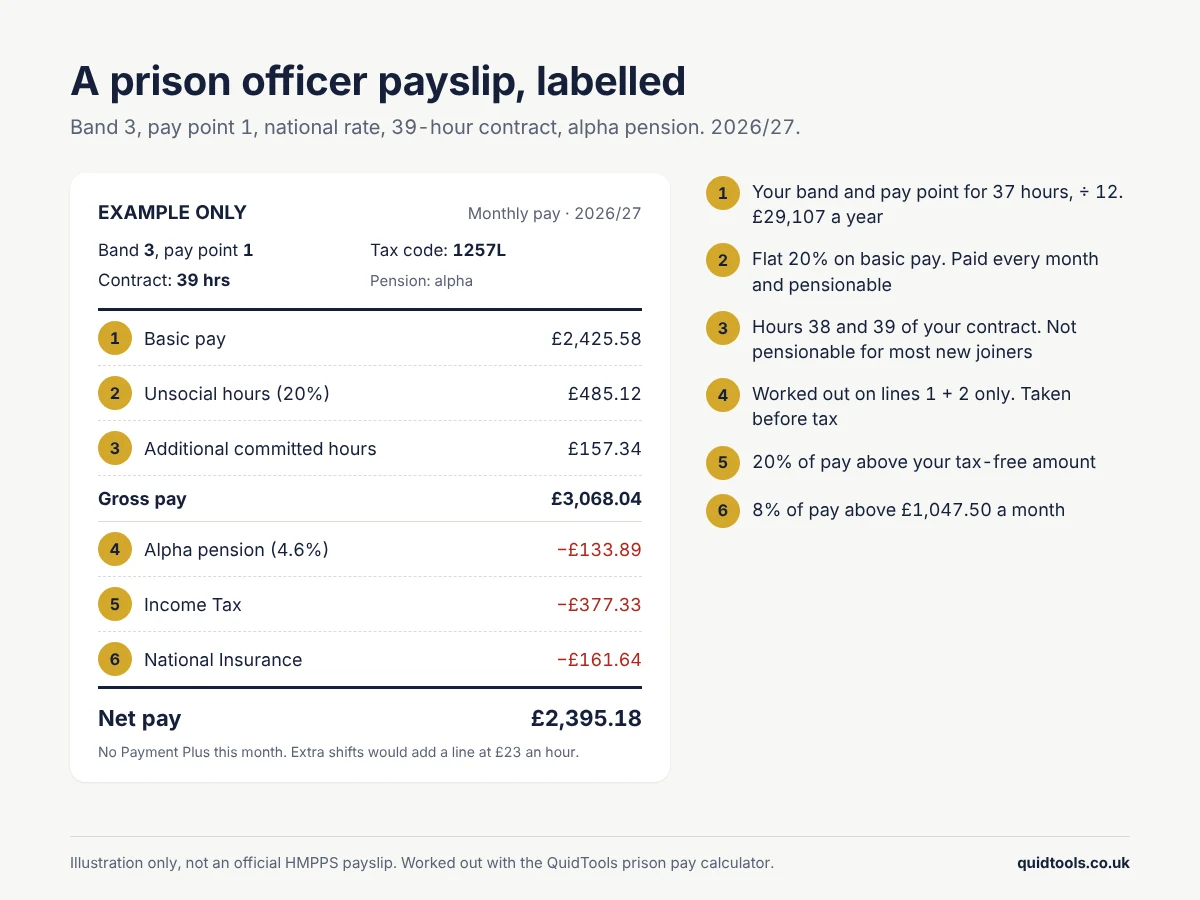
| # | Line | This month |
|---|---|---|
| 1 | Basic pay | £2,425.58 |
| 2 | Unsocial hours allowance (20%) | £485.12 |
| 3 | Additional committed hours (2 a week) | £157.34 |
| Gross pay | £3,068.04 | |
| 4 | Alpha pension (4.6%) | −£133.89 |
| 5 | Income Tax | −£377.33 |
| 6 | National Insurance | −£161.64 |
| Net pay | £2,395.18 |
The wording on your own payslip may be a little different, but the same pieces will be there. Here’s what each one means.
The pay lines
1. Basic pay. This is your band and pay point salary for a 37-hour week, divided by 12. For a new Band 3 officer nationally that’s £29,107 a year. It’s the figure people often don’t recognise, because the advertised £34,928 starting salary already includes the next line.
2. Unsocial hours allowance. Band 3 officers get a flat 20% on top of basic pay for working evenings, nights, weekends and bank holidays. You get it whether or not you worked unsocial hours that month, because it’s built into the job, and it counts towards your pension. Our prison officer unsocial hours page compares it across bands.
3. Additional committed hours. If you’re on a 39 or 41-hour contract, the hours above 37 are paid on a separate line. On 39 hours that’s about £157 a month extra for a new officer. For most new joiners these hours don’t count towards your pension. The exception is staff who moved across from the old 39-hour structure, who may see ACHP (additional committed hours, pensionable) for hours 38 and 39 instead.
Payment Plus. Extra shifts appear as Payment Plus at £23 an hour, the same flat rate whatever your band. It’s taxed and has National Insurance taken off like the rest of your pay, but it doesn’t count towards your pension.
| Payment Plus in a month | Extra gross | Extra take-home |
|---|---|---|
| 8 hours | £184.00 | £132.47 |
| 16 hours | £368.00 | £264.95 |
The Payment Plus calculator shows what any number of extra hours is worth after tax.
On-call. If you’re on call, it shows as its own line: £9 for a work-day period of 12 hours or more, and £25 for each 24-hour period on a rest day, weekend or bank holiday. Two rest-day on-calls add £50 before deductions, about £36 after tax and NI. Like Payment Plus, it doesn’t count towards your pension.
London pay and market supplements. If you work in London, your basic pay is on the outer or inner London scale rather than the national one, so it’s simply higher. You won’t usually see a separate London line. Some hard-to-staff prisons also pay a market supplement, which should show as its own line. Our London prison officer pay page has the London rates.
The deductions
4. Alpha pension. Most HMPPS staff are in the Civil Service alpha scheme. The rate depends on your pensionable pay: 4.6% up to £36,199 a year and 5.45% from £36,200 to £56,000. It’s worked out on basic pay plus unsocial hours, not on extra hours or Payment Plus. It comes off before tax, so you get tax relief straight away. The civil service pension calculator shows what it builds up to.
5. Income Tax. You pay 20% on earnings above your tax-free allowance, up to £50,270 a year, and 40% above that. Most Band 3 officers stay in the 20% band. Your tax code is usually 1257L. If it isn’t, our guide to tax codes explains what the letters mean and what to do.
6. National Insurance. 8% on earnings between £1,047.50 and £4,189.17 a month, and 2% above that. It’s worked out on each month’s pay on its own, so a month with lots of Payment Plus means more NI that month.
Other deductions you might see:
- Union subs, if you’ve joined the POA or another union through payroll.
- Student loan, if your pay is over your plan’s threshold. On the example payslip a Plan 2 loan takes £55.67 a month, bringing take-home down to £2,339.50. Not sure which plan you’re on? See which student loan plan am I on.
- Salary sacrifice, for schemes like cycle to work, which come off before tax.
What the payslip looks like at each band
Same setup as the example (national rate, alpha pension), but on 37 hours so the bands compare like for like.
| Band | Gross a month | Pension rate | Take-home a month |
|---|---|---|---|
| Band 3, pay point 1 | £2,910.70 | 4.6% | £2,281.89 |
| Band 3, pay point 2 | £3,012.50 | 4.6% | £2,351.44 |
| Band 3, pay point 3 | £3,064.80 | 5.45% | £2,366.33 |
| Band 4, supervising officer | £3,444.00 | 5.45% | £2,622.82 |
| Band 5, custodial manager (pay point 1) | £3,741.70 | 5.45% | £2,824.19 |
Every band and pay point, on 37, 39 and 41 hours, is on our prison officer pay page.
Why moving up a pay point doesn’t add as much as you’d think
Going from pay point 1 to pay point 3 adds £154.10 a month before deductions. Your take-home only goes up by £84.44.
Part of that is tax and NI, but the bigger reason is your pension rate. At pay point 3, basic pay plus unsocial hours comes to £36,778, which is over the £36,200 alpha threshold. Your rate goes from 4.6% to 5.45%, and the higher rate applies to all your pensionable pay, not just the part above the line.
It isn’t money lost. It all goes into your pension. But it explains why the April payslip after progression can feel like a let-down.
37, 39 or 41 hours on the payslip
| Contract | Extra hours line | Take-home a month |
|---|---|---|
| 37 hours | none | £2,281.89 |
| 39 hours | £157.34 | £2,395.18 |
| 41 hours | £367.17 | £2,546.25 |
That’s Band 3, pay point 1, national. The 41-hour line is more than double the 39-hour one, because hours 40 and 41 are paid at a higher rate.
In London
A new Band 3 officer at an inner London prison on 39 hours earns £3,621.05 a month before deductions and takes home £2,751.94. The pension rate is 5.45% from day one, because London basic pay plus unsocial hours is already over £36,199.
Your first payslip
Your first payslip is the one most likely to look odd. Three things usually explain it:
- Part-month pay. If you started partway through the month, you’re only paid for the days you were employed. Our guide to part-month salary shows how that’s worked out.
- Emergency tax code. If payroll didn’t get your P45 in time, you may be on an emergency code, often 1257L with W1 or M1 after it. You may pay a bit too much tax for a month or two, but it comes back automatically once the right code arrives.
- Training. You’re paid from day one, including while you train, so there shouldn’t be a gap.
Why your pay changes from month to month
- Overtime. Payment Plus is often paid in arrears, so shifts you do this month may show up on next month’s payslip.
- Pay rise and back pay. Pay awards often arrive after April. The 2026/27 award of 3.5% was backdated to 1 April 2026, so when it was applied you’d have seen a one-off back pay line on top of your new rate.
- Pay progression. If you’re below the top of your band, you normally move up a pay point each April. Band 3 has three pay points.
- Tax code changes. HMRC can change your code during the year, which changes your tax straight away.
How back pay works out. Say the award is applied in August. A new Band 3 officer on 37 hours went from £33,746 to £34,928, which is £98.53 a month more. Four months of arrears, April to July, is about £394 before deductions, paid in one go. Pension comes off, then tax and NI at your normal rates, leaving roughly £270. It isn’t taxed at a special rate. It just lands in one month, which can make that month’s tax look high.
Year-to-date figures, tax period and P60
Your payslip should show running totals since 6 April for pay, tax and NI, plus the tax period: month 1 is April, month 8 is November. If your tax-to-date looks too high for the month you’re in, that’s often the first sign your tax code is wrong. After each tax year you’ll get a P60 with the year’s totals. Keep it, because you’ll need it for mortgage applications and tax refunds. Our general guide to reading a payslip covers these boxes in more detail.
If you work at a private prison
Officers at prisons run by private companies aren’t paid on HMPPS bands. Their payslips follow the employer’s own structure, so the unsocial hours line, committed hours and alpha pension in this guide may not appear. Check your contract and your employer’s pay policy instead.
Five things worth checking
- Your pay point. After April, check you’ve moved up if you should have.
- Your contracted hours. If you’re on 39 or 41 hours, make sure the extra hours line is there and right.
- Allowances after a move. If you transfer to another prison, check the unsocial hours allowance and any market supplement carried over correctly. A missing supplement on the first payslip after a move is a common slip.
- Payment Plus. Match the hours paid against the shifts you actually did.
- Your tax code. It should match last month unless you know why it changed.
If something’s wrong, raise it with your line manager or HR and ask for it to be backdated. Tax code problems go to HMRC rather than your employer.
The bottom line
Most payslip problems turn up in the month after something changes: a new prison, a pay rise, a new contract or a new tax year. Check those payslips line by line, and if something’s missing, raise it straight away and ask for it to be backdated.
Check your own figures
Our take-home pay calculator has a prison service setting. Pick your band, pay point, area and contracted hours, add any Payment Plus, and it shows the same lines as your payslip, so you can check them side by side.
Related reading: prison officer starting salary, is overtime taxed more? and tax codes explained.
This is general information. Figures are for 2026/27, HMPPS staff in England and Wales, worked out with the QuidTools prison pay calculator. Payroll rounds some figures differently, so your payslip may be a few pence out.
Sources
Common questions
Why is my basic pay lower than my advertised salary?
The advertised salary includes the 20% unsocial hours allowance, which is paid on its own line. A new Band 3 officer has £29,107 basic plus £5,821 unsocial hours, which makes £34,928.
Is the unsocial hours allowance pensionable?
Yes. Your alpha pension is worked out on basic pay plus unsocial hours.
Is Payment Plus pensionable?
No. It is paid at £23 an hour and has tax and National Insurance taken off, but it does not count towards your pension.
Why is my overtime taxed so much?
It is taxed at the same rate as the rest of your pay. It feels heavy because tax, NI and sometimes student loan all come off the top slice. On the basic rate you keep about 72p of every pound.
Why did my pension deduction jump after a pay rise?
You probably crossed the £36,200 alpha threshold, so your rate moved from 4.6% to 5.45%. The new rate applies to all your pensionable pay, not just the part above the line.
How is back pay taxed?
At your normal rates, in the month it is paid. It can push that month’s tax up, but there is no extra tax on it.
Do I get paid while I am training?
Yes. You are paid your salary from your first day, including while you train.
Who do I contact if my payslip is wrong?
Start with your line manager or HR, and ask for any underpayment to be backdated. Tax code problems go to HMRC.