Is your tax code wrong? How to read 1257L, BR, 0T and K codes
Most people never look at their tax code. It sits on the payslip next to your National Insurance number, a jumble of numbers and a letter, and as long as the pay goes in, it gets ignored. That’s fine when it’s right. When it’s wrong, it can quietly cost you hundreds of pounds a year, and nobody will tell you.
The good news is that you can check it in about thirty seconds once you know what you’re looking at.
What a tax code actually does
Your tax code is an instruction from HMRC to whoever pays you. It tells them how much you can earn tax-free and whether anything unusual needs adjusting. Your employer doesn’t decide it; they just apply what HMRC sends them.
For most people with one job and nothing complicated going on, the code for 2026/27 is 1257L.
The number: your tax-free pay, divided by ten
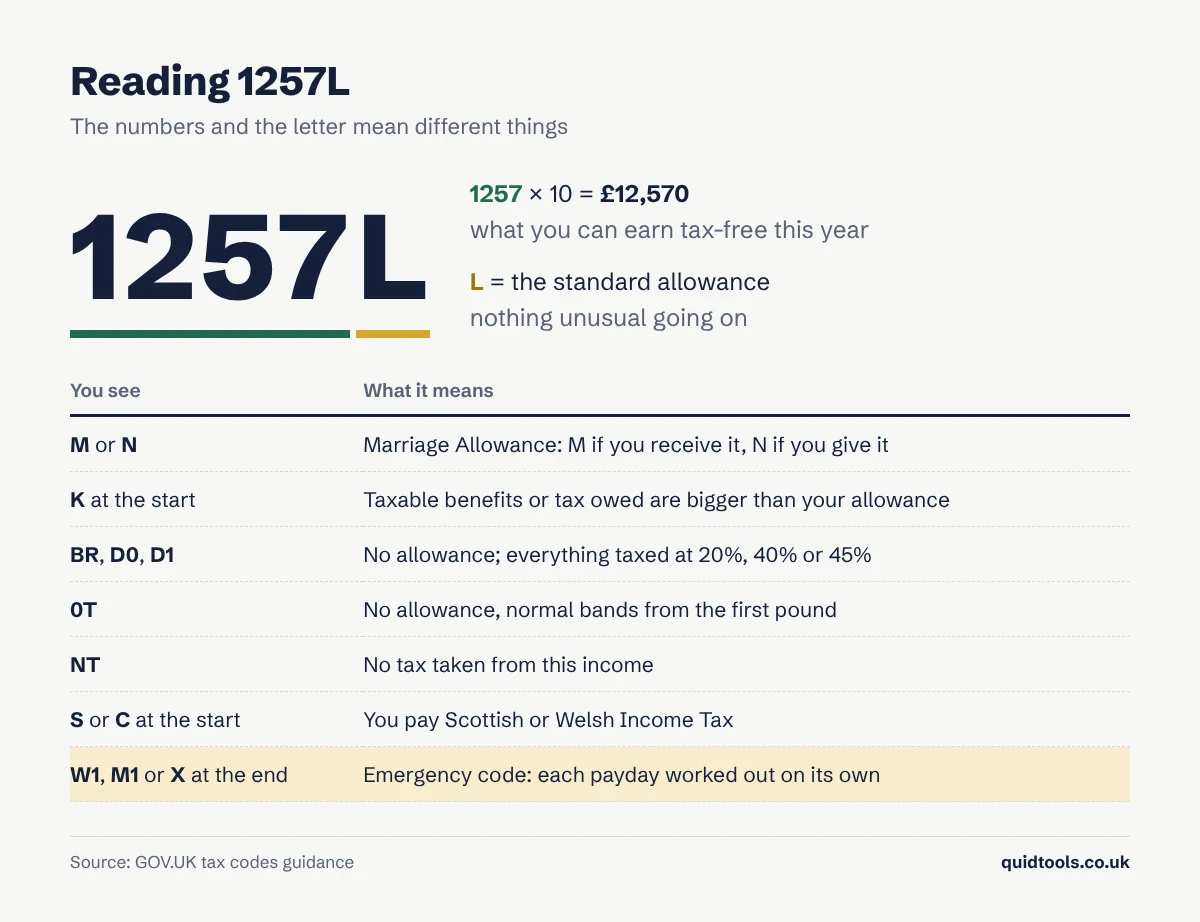
Take the number and add a zero. 1257 becomes £12,570, which is the standard personal allowance: the amount you can earn in a tax year before Income Tax starts. A lower number means HMRC is giving you less tax-free pay, usually because it’s collecting tax on something else through your wages, like a company car or private medical insurance.
If you’re married or in a civil partnership and your partner has transferred some of their allowance to you, your number goes up to 1383 and the letter becomes M. If you’re the one who gave it away, you’ll see 1131N instead.
The letters that should make you look twice
BR means all the pay from that job is taxed at 20%, with no tax-free amount at all. It’s normal on a second job, because your allowance is already being used by your main one. On your only job, it’s almost certainly a mistake.
0T also gives you no allowance, but tax is worked out in the normal bands from the first pound. You often see it when you start a job without a P45. On a £30,000 salary, BR and 0T take exactly the same tax; the difference only shows once you earn enough to reach the higher rate.
D0 and D1 tax everything at 40% or 45%. They’re used for a second income when your main one already puts you in a higher band.
K at the front is the one that confuses people most. It means the things HMRC is taxing through your wages add up to more than your allowance, so instead of giving you tax-free pay, the code adds to your taxable pay. K475, for example, adds £4,750. There is a safety net: a K code can’t take more than half your pay in tax in any one pay period.
NT means no tax at all is taken from that income. It’s rare, and you’d normally know why you have it.
Emergency codes: W1, M1 and X
If your code ends in W1, M1 or X, you’re on what’s called an emergency code. Normally your tax is worked out on a running total across the year, so if you earned less in some months, the system catches up and refunds you automatically. An emergency code switches that off and treats every payday as if it were the only one.
That’s usually temporary. It tends to appear when you start a new job and HMRC hasn’t caught up yet. If it’s still there after a couple of payslips, it’s worth chasing.
How much a wrong code costs
To show the difference, I put the same £30,000 salary through our take-home calculator with different codes. Nothing else changes: same job, same pay, same National Insurance.
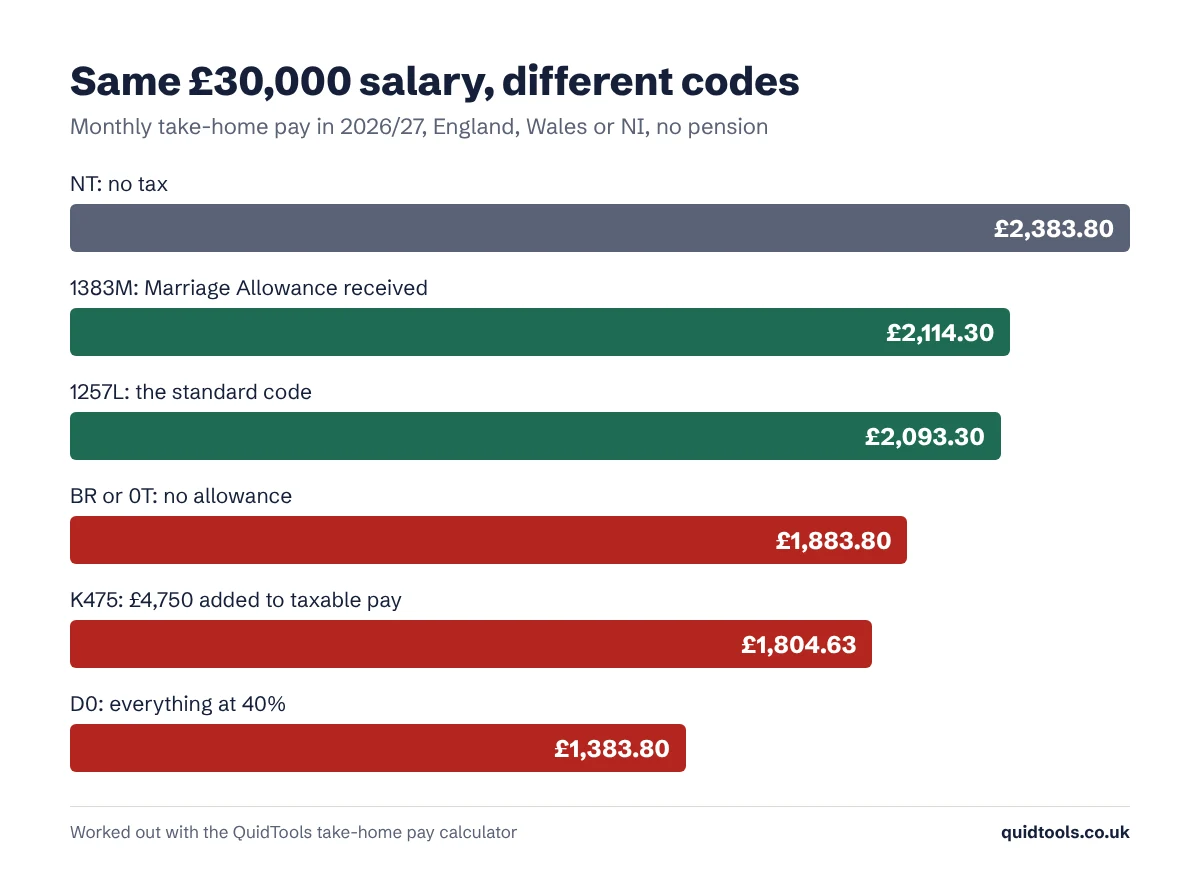
The one that catches people out is BR on a single job. It costs £209.50 a month compared with 1257L, which is over £2,500 across a year. You’d get it back eventually, but that’s a lot of your own money to have sitting with HMRC.
Where to find your code, and how to fix it
Your code is on every payslip, usually near the top. You can also see it, and the reasons behind it, in the HMRC app or your personal tax account on GOV.UK. That’s also where you’ll see which job your allowance is being used against if you have more than one.
If something looks wrong, tell HMRC rather than your employer. You can do it through the app or by phone. Once HMRC issues a new code, your employer has to use it, and any tax you’ve overpaid is usually refunded through your next payslips. If the tax year has already ended, HMRC will work it out and send a P800 calculation, with any refund paid to your bank account.
A few common reasons a code changes that are perfectly normal:
- you’ve started getting a taxable benefit, like a company car or health insurance
- you owed a small amount of tax from last year and HMRC is collecting it through your wages
- you’ve started a second job or begun drawing a private pension
- you’ve reached State Pension age and the State Pension is using part of your allowance
Check yours now
Put your salary and your tax code into our take-home pay calculator and compare the result with your payslip. If you have more than one job, the second job tax calculator shows which code each job should be on, and whether you’d be better off splitting your allowance.
This is general information, not tax advice. Figures are for the 2026/27 tax year in England, Wales and Northern Ireland. Scottish taxpayers have different bands, and their codes start with S.