Child Benefit and the High Income Charge: who pays it back and how to reduce it
Child Benefit is one of those payments most parents claim without thinking much about it. Then one of you gets a pay rise, crosses £60,000, and a letter arrives from HMRC asking for some of it back. Plenty of people get caught by this because nobody told them the rule existed.
It’s called the High Income Child Benefit Charge. Here’s how it works, and what you can do about it.
How much Child Benefit is worth
In 2026/27, Child Benefit pays £27.05 a week for your eldest child and £17.90 a week for each child after that. Over a year, that’s £1,406.60 for one child and £2,337.40 for two. It isn’t means-tested: anyone responsible for a child under 16, or under 20 in approved education or training, can claim it.
When you have to pay it back
The charge starts when either parent’s income goes over £60,000. Above that, the higher earner repays 1% of the Child Benefit for every £200 they earn. By £80,000, it’s all repaid.
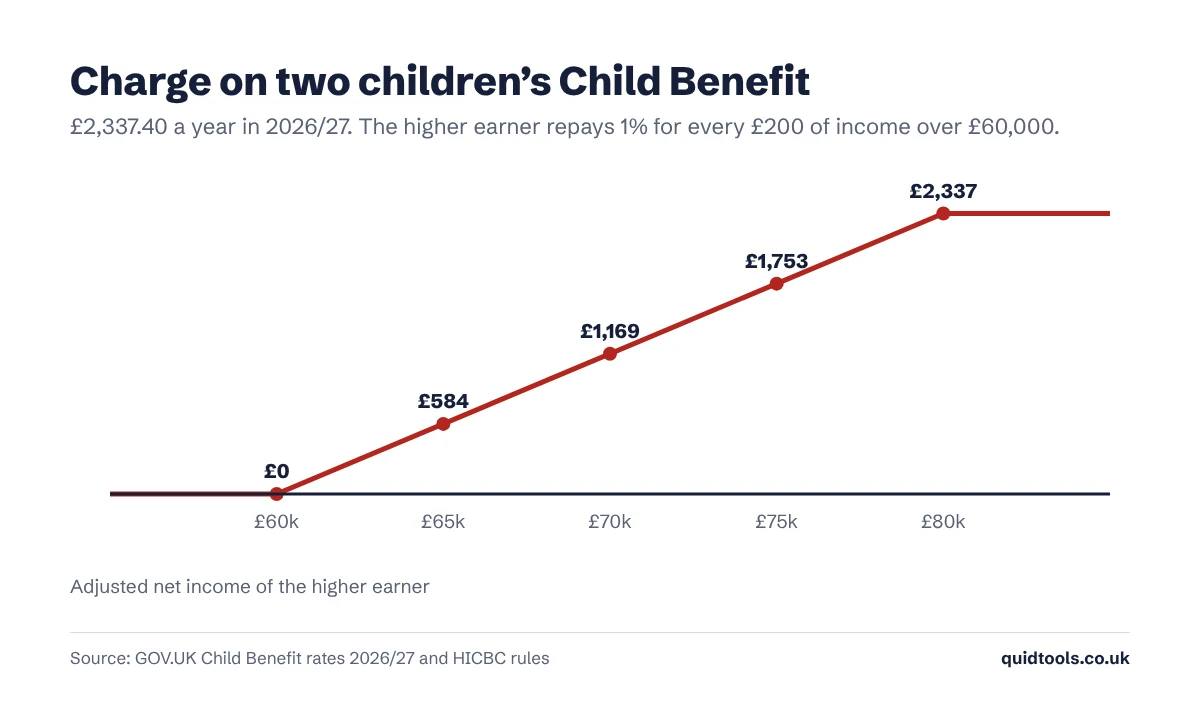
Two details matter here. First, it’s based on each parent’s own income, not your household’s. A couple earning £55,000 each pay nothing, while a single earner on £70,000 pays half back. Second, the charge always falls on whichever partner earns more, even if the other partner is the one receiving the money.
The income figure used is your adjusted net income: your total taxable income, including things like savings interest, rental income and bonuses, minus pension contributions and Gift Aid donations.
Should you still claim if you earn over £80,000?
Usually, yes, even if you then opt out of the payments. Registering for Child Benefit gives the parent who stays at home National Insurance credits towards their State Pension, and it means your child is sent their National Insurance number automatically at 16. You can fill in the claim and then tell HMRC you don’t want the money, so there’s no charge to pay.
How you pay the charge
Traditionally you had to register for Self Assessment and pay it through a tax return. If you’re employed and don’t otherwise need a tax return, HMRC now lets most people pay it through their tax code instead, so it’s taken from your wages over the year. Either way, it’s your responsibility to tell HMRC: if you don’t and they find out, you can be charged penalties on top.
How to reduce or avoid the charge
Because the charge is based on adjusted net income, anything that lowers that figure lowers the charge. The most effective option by far is paying more into your pension.
Take a parent earning £70,000 with two children. Their charge is £1,168.70. If they put an extra £10,000 a year into their pension through salary sacrifice, their adjusted net income drops to £60,000 and the charge disappears completely. They also save £4,000 in higher-rate tax and £200 in National Insurance. So £10,000 goes into the pension, but their take-home pay only falls by about £4,630. That’s one of the best deals in the whole tax system.
Gift Aid donations work the same way, as do some other salary sacrifice schemes like electric cars or cycle-to-work.
It’s also worth checking which partner is the higher earner if your incomes are close, because only their income counts.
Check your own figures
Our take-home pay calculator includes the High Income Child Benefit Charge. Tap “Child Benefit”, add your number of children, and it shows how much you’ll repay, and what happens if you pay more into your pension. If you’re near £100,000 as well, read our guide to the 60% tax trap, because the same pension trick works there too.
This is general information, not tax advice. Figures are for the 2026/27 tax year. If you’re unsure whether you owe the charge, HMRC’s online Child Benefit tax calculator or a tax adviser can help.