Statutory sick pay in 2026: how much you will get under the new day-one rules
For years, statutory sick pay had two rules that caught out the people who could least afford it. You got nothing for your first three days off, and if you earned under about £125 a week, you got nothing at all. Both of those went in April 2026.
If you haven’t been off sick since then, you might not know the rules have changed. Here’s how sick pay works now, and how much you’re likely to get.
What changed in April 2026
Three things changed on 6 April 2026, under the Employment Rights Act:
- No more waiting days. Sick pay now starts from your first day off, not your fourth.
- No minimum earnings. The old earnings threshold has gone, so low-paid and part-time workers now qualify.
- A new 80% rule. You get £123.25 a week, or 80% of your average weekly earnings if that’s lower. That stops someone on very low pay getting more when sick than when working.
You still need to be an employee or worker on your employer’s payroll. Self-employed people don’t get statutory sick pay.
How much you’ll get
Sick pay is worked out as a weekly amount, then split by the number of days you normally work. So if you work five days a week, each sick day is worth a fifth of £123.25, which is £24.65.
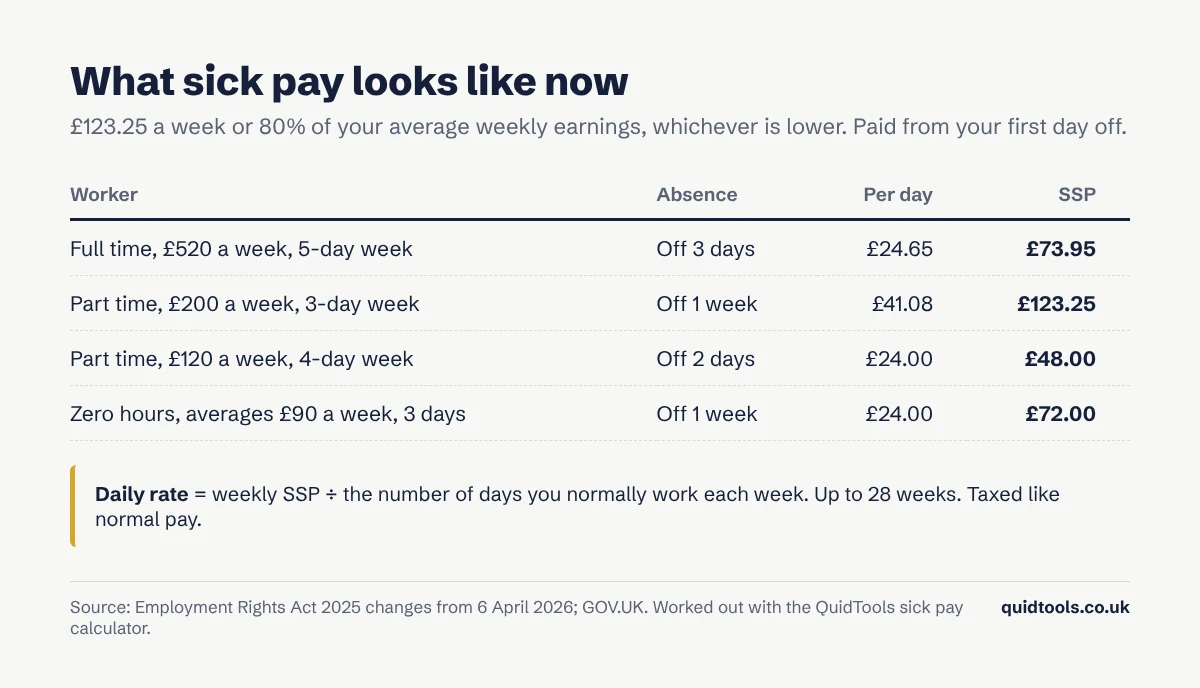
Your average weekly earnings are based on the eight weeks before you went off sick, using the pay you’d normally pay National Insurance on. For most full-time workers that’s well above £154 a week, so they get the full £123.25. The 80% rule mainly matters if you work a few hours a week.
Sick pay can be paid for up to 28 weeks in any one period of sickness. It’s taxed and has National Insurance taken off like normal pay, so what lands in your account may be a bit less.
Your employer may pay more
Statutory sick pay is the legal minimum. Many employers pay full pay, or a percentage of it, for a set number of weeks instead. This is called contractual or company sick pay, and it’ll be in your contract or staff handbook. If your employer pays more than SSP, you get their rate, not both.
What you need to do
Tell your employer you’re sick as soon as you can, following whatever process they’ve set. For the first seven days you can self-certify, which usually just means filling in a form when you’re back. After seven days you’ll normally need a fit note from a GP, hospital doctor, nurse or pharmacist.
If you’re coming back gradually on a phased return, you can now get sick pay for the days you’re off, which wasn’t possible before.
If you don’t qualify
If you’re self-employed, or you’ve been off longer than 28 weeks, statutory sick pay won’t cover you. You may be able to claim Universal Credit or New Style Employment and Support Allowance instead, depending on your circumstances and National Insurance record. Citizens Advice can help you work out which applies.
And if you think your employer isn’t paying you correctly, raise it with them first. If that doesn’t work, HMRC deals with statutory sick pay disputes, and Acas offers free advice.
Work out your sick pay
Our sick pay calculator uses the April 2026 rules. Put in your weekly pay, the days you normally work and how long you’ve been off, and it shows what you’re owed. To see what it does to your monthly pay after tax, try the take-home pay calculator.
This is general information, not legal advice. Figures are for the 2026/27 tax year in England, Scotland and Wales. Northern Ireland has its own sick pay rules.