Will you ever pay off your student loan? What Plan 2 and Plan 5 graduates really repay
If you graduated in England in the last decade, your student loan balance has probably gone up, not down, even while you’ve been making repayments. That’s a horrible thing to see on a statement, and it leads a lot of people to the same question: am I ever going to clear this?
For most graduates the honest answer is no. That’s often fine, and sometimes it’s actually the better outcome. Student loans work very differently from any other debt, and once you understand how, the scary balance matters a lot less than you’d think.
It works more like a tax than a loan
You don’t repay a fixed amount. You repay 9% of whatever you earn above a threshold, through your payslip, for a set number of years. Earn less, pay less. Earn nothing, pay nothing. After the set term, whatever’s left is written off, and it doesn’t affect anyone else in your family.
The two plans most current graduates are on:
- Plan 2 covers most people who started university in England or Wales between 2012 and July 2023. You repay above £29,385 a year, and anything left is written off after 30 years. Interest ranges from inflation (RPI) up to RPI plus 3% depending on what you earn, and is currently capped at 6%.
- Plan 5 covers students in England who started from August 2023. You repay above £25,000, interest is RPI only, but the term is 40 years.
What you’ll actually repay
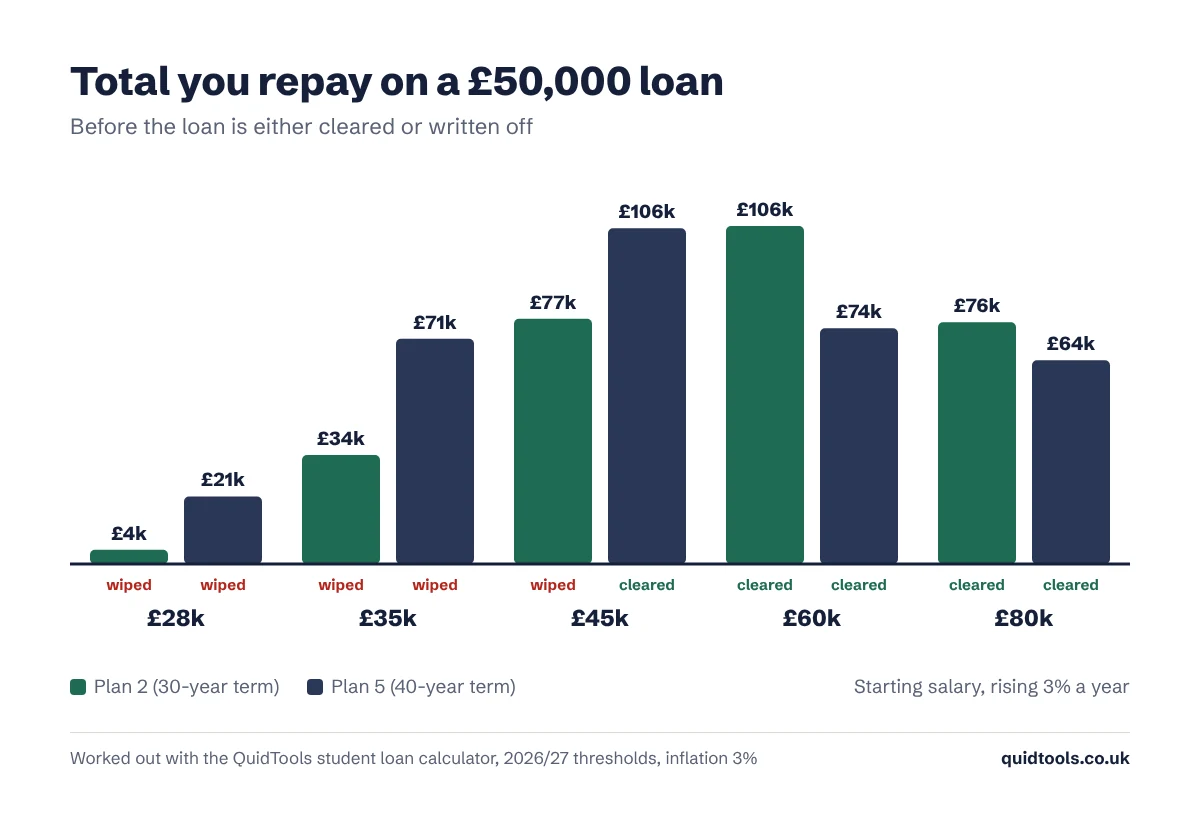
The balance on your statement tells you surprisingly little. What matters is your salary over the next 30 or 40 years. To show this, I ran a £50,000 loan through our student loan calculator at different starting salaries, assuming pay rises of 3% a year.
Two things jump out.
First, on Plan 2, it’s the middle earners who pay the most. Someone starting on £60,000 repays about £106,000 before they clear the loan. Someone starting on £80,000 repays less, about £76,000, because they clear it faster and so less interest builds up. Lower earners pay much less and have the rest written off.
Second, Plan 5 hits lower and middle earners much harder. The lower threshold and the extra ten years mean that someone starting on £35,000 repays about £71,000 on Plan 5, against £34,000 on Plan 2. Far more Plan 5 graduates will clear their loans in full.
So should you pay it off early?
This is where the “it’s like a tax” idea really matters. If you’re on Plan 2 and unlikely to clear the loan before it’s written off, every pound you overpay is a pound you’d never have had to pay at all. You’d just be reducing a balance that was going to disappear anyway.
Overpaying only makes sense if you’re confident you’d clear the loan within the term regardless, in which case overpaying cuts the interest you pay. That usually means a high and steady income. Even then, it’s worth comparing it with paying into a pension or clearing more expensive debt first.
On Plan 5, more people will clear their loan, so the maths shifts towards overpaying being worthwhile for higher earners. But the same rule applies: run your own numbers before sending HMRC money you might not owe.
A few things that catch people out
- The threshold is frozen. Plan 2’s £29,385 stays put until April 2030, so as your pay rises you’ll repay a little more each year.
- Repayments are per payday. If you have a big bonus month, more comes off that month. If your income dips, you can claim back anything you overpaid once the year ends.
- A postgraduate loan is extra. If you also have a Master’s or PhD loan, you repay 6% above £21,000 on top of your undergraduate repayments.
- Self-employed? Repayments are collected through your Self Assessment tax return rather than your payslip.
Run your own figures
Put your plan, balance and salary into our student loan calculator. It shows whether you’re likely to clear the loan, how much you’ll repay in total and the year it would be written off. To see what the repayment does to your monthly pay, add your plan in the take-home pay calculator.
This is general information, not financial advice. Projections assume steady 3% pay rises and inflation, and current rules. Real outcomes depend on your career, and the government can change loan terms.